
Scaling up with PhotonHub
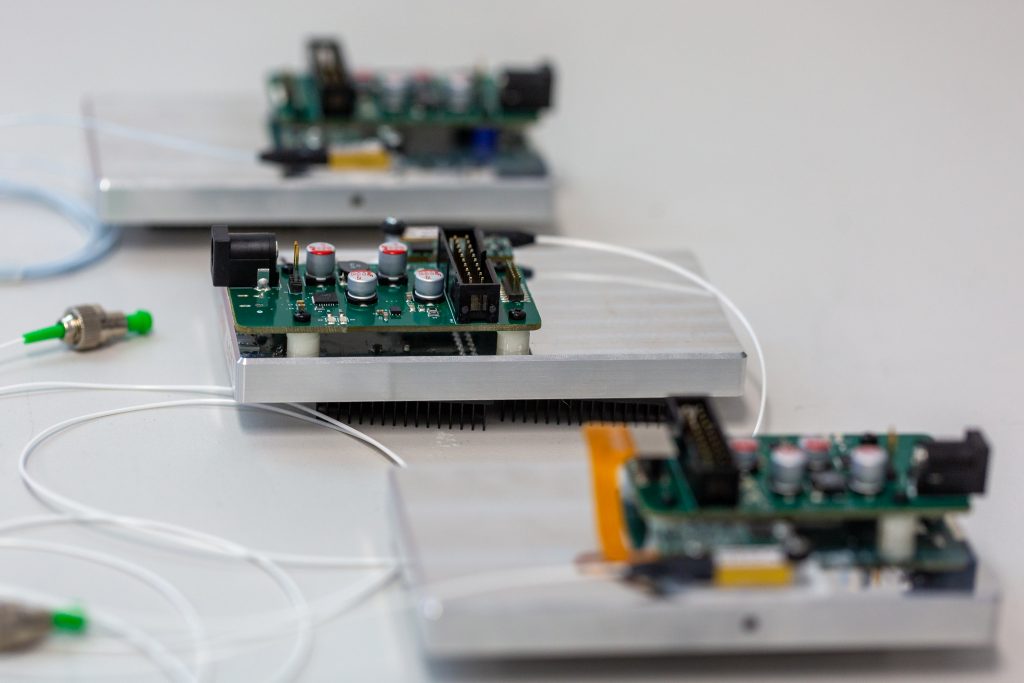
We recently wrapped up a couple of upscaling projects as we prepare our products for larger scale production. This is how we are preparing for volume! No matter the application, market, or the technology, every startup with a physical product reaches the same make or break stage: can the product scale? In our case, Pilot Photonics is leveraging the scalability of photonic chips to make optical solutions smaller, cheaper, and more power efficient. Still, photonic integrated circuit (PIC) devices go through many iterations in circuit design, process engineering, assembly optimisation, packaging approaches, and control algorithms. Projects like PhotonHub Europe, funded by the European Commission through the Horizon Europe programme, are designed to support product developers like Pilot through those development stages. We have just wrapped up a couple of scale-up projects to improve the Technology Readiness Levels (TRL) of two of our products. Our integrated comb laser assembly (iCLA) and our nano-integrated tuneable laser assembly (nano-iTLA), both based on monolithic indium phosphide PICs, have reached new levels of manufacturability thanks to our collaborations with Fraunhofer HHI and SMART Photonics. CLASSYCAL: Comb lasers for millimetre-wave generation The integrated comb laser assembly (iCLA) was initially designed for scaling coherent optical transceivers by delivering multiple coherent wavelengths from a single laser. As we continued developing it, it has received significant interest also for micro-wave and mmWave applications in space, test and measurement, and mobile telecommunications. Project CLASSYCAL was conducted in collaboration with Fraunhofer HHI. The goals of the project were deeper integration and miniaturisation, improved electronics, and better monitoring and control. This included the integration of high speed photodetectors, developed by HHI, for ultra-high speed operation, packaging refinements for improving the thermal performance and deeper integration for manufacturability. Embedded iCLA module produced during project CLASSYCAL We also improved the device’s post production phase. Burn-in protocols were developed to improve its stability. Along with that, we developed closed loop control algorithms, enabling customer field testing. This fed into an early evaluation unit for a variable optical frequency generator unit (OFGU), which we recently published a white paper on. We’re now at a stage where the new miniaturized form-factor is enabling more customer demonstrations and customer feedback is mapping the road ahead for the device development. The next phase will be a design for manufacture with a view to ramping up. NETTLESOUP: Tuneable lasers for high speed operation Our nano-integrated tuneable laser assembly (nano-iTLA) is geared towards optical communications, test & measurement, LiDAR, and coherent optical inter-satellite links. Its high speed tuneability in the nanosecond regime has received a lot of interest from AI data network innovators like Finchetto and satellite communication builders like MBRYONICS. There is continuous pull in our target markets for increased laser output power. This was one of our objectives in NETTLESOUP, along with improving yield, and manufacturability in pilot production runs. In collaboration with SMART Photonics, these targets were achieved. Nano-iTLA module produced during NETTLESOUP, with goldbox laser packaging and wrap-around electronics. On the manufacturability front, we tested out the use of tapered semiconductor optical amplifiers (SOA) to reduce gain saturation and avoid complicated processing, relying on SMART’s improved 4 inch process. Production was streamlined across the board, from mask creation to back-end processing with new benchmarks in time from tape-out to fab-out. With the monolithic integration of the SOAs and the testing out of design variations, we were able to achieve target power, and have seen 18 dBm ex-facet consistently. The tapered SOA also allowed extra feedback resilience, and design variations have made it clear that increasing the tuning range is also possible. What comes next for our integrated lasers Signals from the market have been consistently positive regarding our nano-iTLAs. This is why our primary occupation is making sure that our products can be repeatably manufactured in volume with the performance, yield and reliability demanded by our customers. We are producing and delivering evaluation and design-in modules and taking in all the feedback we’re getting. It is plenty of work for our small team, which is also why we are stoked about the funding we recently received via the European Innovation Council. We are planning on growing locally and internationally, and will accelerate our product work with every new colleague. Getting Pilot Photonics to this stage has taken a lot of work, funding, and building trust. Programmes like PhotonHub are instrumental in stimulating the European ecosystem, enabling small companies to bring innovative deep tech products to various markets. We are very proud of the progress we have been making, and look forward to sharing more project results with you in the near future!
AI Datacentre the size of a city?

Now that the dust has settled after OFC here are some of our thoughts and take-aways: Co-packaged Optics Breaks Through In the lead-up to OFC 2025, the tone was set at Nvidia GTC when CEO Jensen Huang heralded their co-packaged optics (CPO) solution for scale out networking, announcing: “AI factories are a new class of data centers with extreme scale, and networking infrastructure must be reinvented to keep pace. By integrating silicon photonics directly into switches, NVIDIA is shattering the old limitations of hyperscale and enterprise networks…”. Although Broadcom, Ranovus and others had been making superb progress on CPO for several years, the Nvidia-factor brought it mainstream and created a notable buzz and hype around OFC. It was the largest OFC in more than 20 years with talk of renewed interest from investors and an increase in attendance. There certainly seemed to be a greater footfall, although it’s unclear whether the huge crowds and 90 minute queues on the opening morning were due to sheer numbers, or whether they were the result (ironically) of internet connectivity and technology issues! City Scale AI Datacentres At the Optica Executive Forum the keynote speaker from Google, Amin Vahdat, gave a fascinating talk about the past, present and future of AI networking. There was a ‘shivers down the spine’ moment as he likened it to being present at the dawn of the internet and the launch of the first browser sitting on the world wide web. It is, without doubt, exciting and exhilarating, and it is a privilege to be contributing in some small way to this revolution. We heard about Meta’s plan for a 2 gigawatt AI Factory that would cover the same area as much of Manhattan! And this is just one such project. Whilst AI developments are incontrovertibly moving forward at pace, and offer huge potential, could there be parallels with the bubble 25 years ago when the ‘new era’ of the world wide web resulted in overbuild of infrastructure coupled with over-inflated valuations? While we’re not there yet, a little bit of caution does seem warranted. Key Highlights from Pilot Photonics’ OFC 2025: Overall it was an OFC buzzing with anticipation and excitement: let’s keep the momentum going. 💡
Enabling the Next Generation of Space Communication, Observation and Science
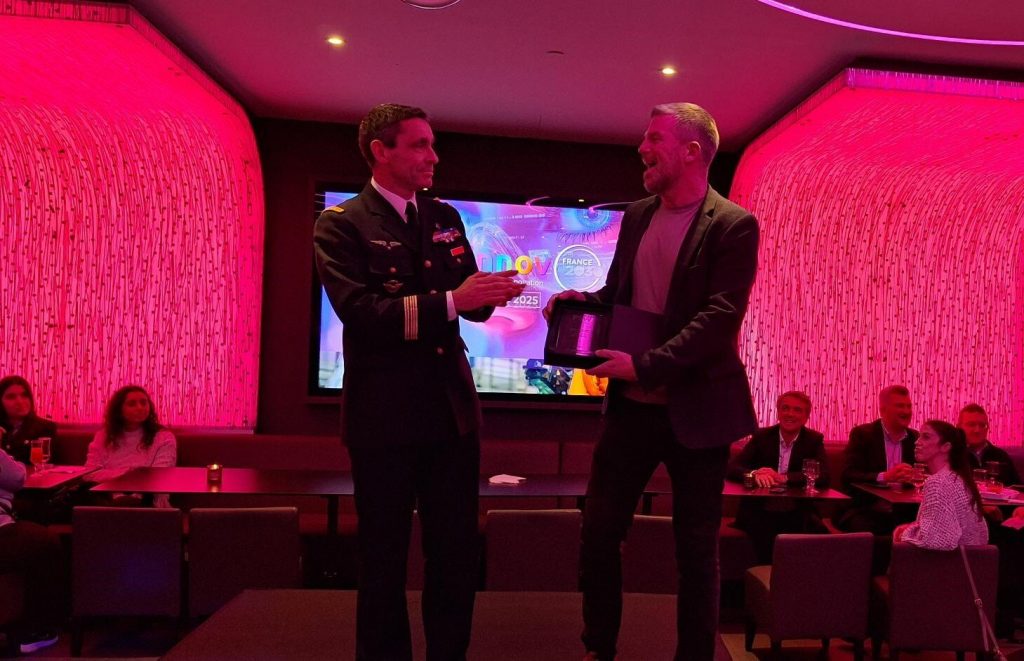
In February 2025 Pilot Photonics attended the Paris Space Week for the first time, exhibiting as part of the Irish Pavilion. Our application to participate in the PSW Innovation Challenge was accepted, and CTO and Co-Founder of Pilot, Frank Smyth delivered a presentation entitled ‘Astro-FGTM: Agile Optical Frequency Generator’ to a panel of judges. At the awards ceremony later the same day, we learnt that we had won the Innovation Challenge, with an award presented by Colonel Noël Farnaud. Needless to say, we’re thrilled and proud to receive this recognition of our innovation in space communications, observation and science. Pilot Photonics’ Co-Founder and CTO being presented with the PSW Innovation Challenge Award by Colonel Noël Farnaud from the French Space Command What was significant about what we said? Read on… The next generation of advanced space applications will demand for higher frequency components – needed for faster data rates and more precise measurements. Traditional electronic approaches struggle to provide the frequencies, bandwidth and noise performance required within an acceptable cost, size, weight and power envelope. So new innovations are needed. The Limitations and Hurdles: Pilot Photonics’ breakthrough is in being able to generate microwave, mmWave and sub-THz frequencies on its ASTRO-FGTM platform by leveraging the optical domain and photonic integration. Optical frequencies are roughly 10,000 times higher than the GHz range we typically use in microwave electronics. This breakthrough combines our optical frequency comb technology, with state-of-the-art photonic integration and advanced semiconductor packaging. Comb lasers are known to bridge the microwave and optical worlds, but how does the ASTRO-FGTM work? We integrate several key functions onto a tiny photonic integrated circuit. First, we apply a low frequency RF signal to the on-chip laser using a technique called gain switching – this generates a comb of optical frequencies spaced precisely by the applied RF frequency. Any two of these optical frequencies can then be selected using an on-chip active optical filter and applied to a high-speed photodetector. This enables us to produce highly stable, low phase noise carriers at the separation frequency of the selected optical carriers which can be anything from 4GHz to 250GHz. In this way we can achieve up to 50X multiplication in a single stage in contrast to electronic methods that typically offer 2 or 3X per stage. mmWave technology enables cutting edge communication, sensing and imaging, whilst photonic approaches enable precise, widely tunable signals in compact, lightweight, power efficient packages – essential when being integrated into payloads where minimising weight is critical. In addition, mmWaves are both EMI and radiation tolerant: hugely beneficial features when working with space applications. Advantages: The world’s first wide range and tunable optical frequency generation and conversion unit (OFGCU), Pilot’s ASTRO-FGTM has a number of advantages: Ultra-Wide Frequency Range: Performance and SWaP: Optical Domain: Future-Proof Platform: Key Applications: The key application areas for Astro-FGTM include: Next Steps: The next step for the ASTRO-FGTM is design-in for next generation space payloads, for which we are looking to partner with integrators and space primes. If this technology is of interest, or you would like to find out more please contact us on: sales@pilotphotonics.com
ECOC 2023 in Glasgow Opens Interest in Tunable Lasers
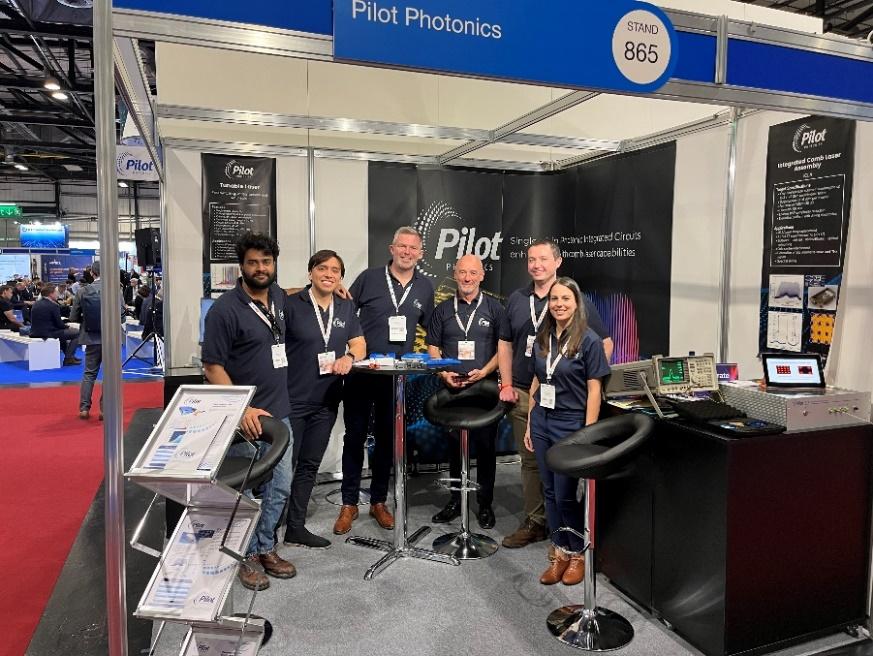
The European Conference on Optical Communication (ECOC) was held over 4 days at the SEC in Glasgow, Scotland in October 2023. Pilot Photonics was there to showcase our latest developments in optical comb and tunable laser technology. It was the 49th edition of the conference, which brings together over 6,700 visitors and 300 exhibitors to discuss their latest breakthroughs and offerings. Visitors to our booth were particularly interested in our widely-tunable lasers in the O-band and C-band. These lasers span 35 nm and offer “step & sweep” tuning today, with a quasi-continuous tuning version coming soon. The lasers are suitable for applications in coherent optical communications in both telecoms and datacoms, fibre sensing, FMCW LiDAR and more. Pilot’s team was led by our CEO, William Oppermann, our founder and CTO, Dr. Frank Smyth, our Director of Sales Damian McGillivary and supported by our team of scientists and engineers who connected with our visitors and enjoyed positive feedback and engaging conversations. Aside from the trade show, our senior photonics engineer, Dr. Caolán Murphy, had the chance to deliver a talk explaining our progress with O-band tunable lasers to a crowd of more than 100 industry and academic professionals devoted to next-generation lasers and detectors. Dr. Murphy described our integrated fast-switching, tunable lasers with SOAs, capable of 14 dBm of laser output power and with linewidths of 150 kHz or less. We extend our gratitude to everyone who visited our booth, engaged in insightful discussions, and expressed interest in our technologies. In 2024, ECOC will be in Frankfurt, Germany and we hope to see you there. For those who couldn’t join us at ECOC 2023, we invite you to explore our showcased products at wwwpilotphotonics.com/products.
ECOC 2022: PILOT USES JePPIX SERVER FOR PHOTONICS TECH
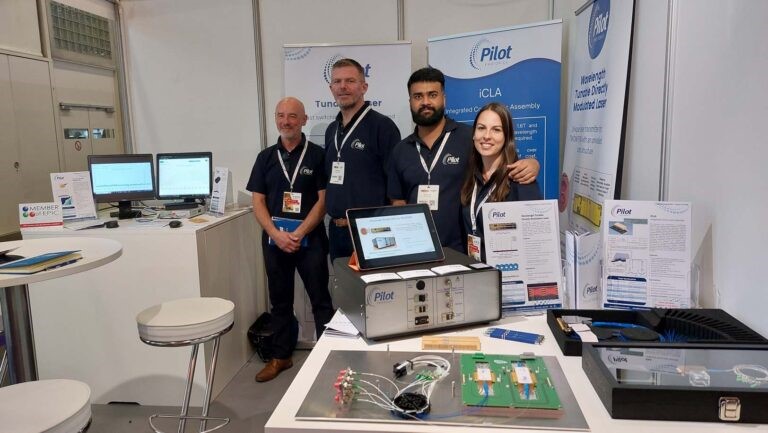
Pilot Photonics demonstrated three new products at ECOC2022 which emanated from the JePPIX platform. These include a low linewidth fast tuneable laser, an InP-based monolithic single mode laser in the C-band; an integrated Comb Laser Assembly (iCLA) for scaling coherent transceiver capacity, and SuperTROSA™ a comb-based superchannel transmitter. Low Linewidth Fast Tunable Laser has a tuning range of > 30nm centered at 1550 nm, with high side-mode suppression ratio. It offers linewidth < 150kHz and low power consumption. This laser is currently offered in a standard 14-pin butterfly package, with a thermo-electric cooler, internal isolators, and polarisation-maintaining fibre pigtail with FC/APC connectors. Development in a nano-iTLA formfactor is underway. The integrated comb laser assembly (iCLA) incorporates a monolithically integrated comb laser and demultiplexer that supplies four or more simultaneously generated coherent, phase matched outputs on separate fibres, replacing up to 4 integrated tuneable laser assemblies (iTLAs). It is designed for driving multiple 400G/800G coherent optical engines on individual fibres from a single laser module. This patented source technology offers the ability to tune the wavelength separation of the four outputs, while maintaining the coherent and phase-matched characteristics, reducing the required DSP complexity The TERA-4-TX is a transmit side optical engine for next-generation coherent superchannel transceivers. It combines a wavelength-tuneable, integrated comb source and demux that supply four simultaneously generated coherent wavelengths to an array of dual polarisation IQ modulators. “JePPIX has allowed us to offer PICS with enhanced performance and capability and enabled us to target new industry verticals,” says Frank Smyth, founder and chief technology officer of Pilot Photonics. Kevin Williams, Professor and chair of the Photonic Integration group at TU Eindhoven, a JePPIX partner, considers it “an excellent example of how an early-stage company can create new products that may route to production thanks to the JePPIX Pilot Line”. Source: Optical Connections
Pilot Photonics participated at ECOC 2022 in Basel

Pilot Photonics attended the European Conference on Optical Communication in Basel this September. The company took its largest trade show booth to date, and six members of the Pilot team demonstrated a number of new and existing products and technologies during a busy three days at the show. The products on display were Off the booth, Pilot Photonics’ CTO Dr. Frank Smyth presented a talk on Pilot’s integrated comb laser assembly (iCLA) at the Product Focus Session. The slides from the talk can be downloaded here [ LINK TO CONTENT].He also spoke about the same technology to the ECOC TV team, and that interview can be viewed below.