
Scaling up with PhotonHub
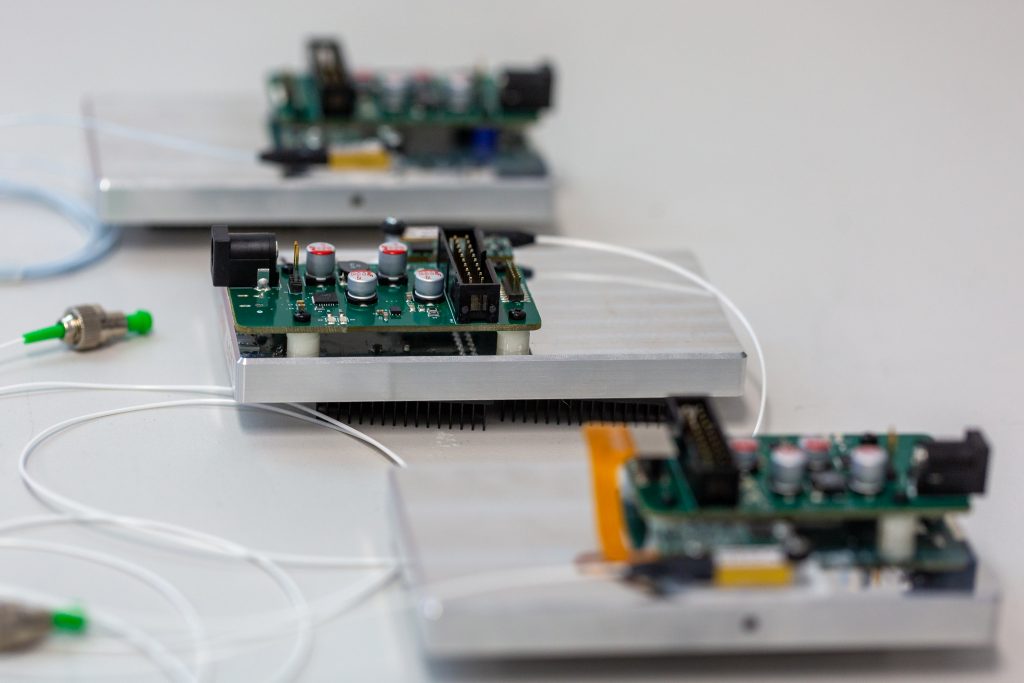
We recently wrapped up a couple of upscaling projects as we prepare our products for larger scale production. This is how we are preparing for volume! No matter the application, market, or the technology, every startup with a physical product reaches the same make or break stage: can the product scale? In our case, Pilot Photonics is leveraging the scalability of photonic chips to make optical solutions smaller, cheaper, and more power efficient. Still, photonic integrated circuit (PIC) devices go through many iterations in circuit design, process engineering, assembly optimisation, packaging approaches, and control algorithms. Projects like PhotonHub Europe, funded by the European Commission through the Horizon Europe programme, are designed to support product developers like Pilot through those development stages. We have just wrapped up a couple of scale-up projects to improve the Technology Readiness Levels (TRL) of two of our products. Our integrated comb laser assembly (iCLA) and our nano-integrated tuneable laser assembly (nano-iTLA), both based on monolithic indium phosphide PICs, have reached new levels of manufacturability thanks to our collaborations with Fraunhofer HHI and SMART Photonics. CLASSYCAL: Comb lasers for millimetre-wave generation The integrated comb laser assembly (iCLA) was initially designed for scaling coherent optical transceivers by delivering multiple coherent wavelengths from a single laser. As we continued developing it, it has received significant interest also for micro-wave and mmWave applications in space, test and measurement, and mobile telecommunications. Project CLASSYCAL was conducted in collaboration with Fraunhofer HHI. The goals of the project were deeper integration and miniaturisation, improved electronics, and better monitoring and control. This included the integration of high speed photodetectors, developed by HHI, for ultra-high speed operation, packaging refinements for improving the thermal performance and deeper integration for manufacturability. Embedded iCLA module produced during project CLASSYCAL We also improved the device’s post production phase. Burn-in protocols were developed to improve its stability. Along with that, we developed closed loop control algorithms, enabling customer field testing. This fed into an early evaluation unit for a variable optical frequency generator unit (OFGU), which we recently published a white paper on. We’re now at a stage where the new miniaturized form-factor is enabling more customer demonstrations and customer feedback is mapping the road ahead for the device development. The next phase will be a design for manufacture with a view to ramping up. NETTLESOUP: Tuneable lasers for high speed operation Our nano-integrated tuneable laser assembly (nano-iTLA) is geared towards optical communications, test & measurement, LiDAR, and coherent optical inter-satellite links. Its high speed tuneability in the nanosecond regime has received a lot of interest from AI data network innovators like Finchetto and satellite communication builders like MBRYONICS. There is continuous pull in our target markets for increased laser output power. This was one of our objectives in NETTLESOUP, along with improving yield, and manufacturability in pilot production runs. In collaboration with SMART Photonics, these targets were achieved. Nano-iTLA module produced during NETTLESOUP, with goldbox laser packaging and wrap-around electronics. On the manufacturability front, we tested out the use of tapered semiconductor optical amplifiers (SOA) to reduce gain saturation and avoid complicated processing, relying on SMART’s improved 4 inch process. Production was streamlined across the board, from mask creation to back-end processing with new benchmarks in time from tape-out to fab-out. With the monolithic integration of the SOAs and the testing out of design variations, we were able to achieve target power, and have seen 18 dBm ex-facet consistently. The tapered SOA also allowed extra feedback resilience, and design variations have made it clear that increasing the tuning range is also possible. What comes next for our integrated lasers Signals from the market have been consistently positive regarding our nano-iTLAs. This is why our primary occupation is making sure that our products can be repeatably manufactured in volume with the performance, yield and reliability demanded by our customers. We are producing and delivering evaluation and design-in modules and taking in all the feedback we’re getting. It is plenty of work for our small team, which is also why we are stoked about the funding we recently received via the European Innovation Council. We are planning on growing locally and internationally, and will accelerate our product work with every new colleague. Getting Pilot Photonics to this stage has taken a lot of work, funding, and building trust. Programmes like PhotonHub are instrumental in stimulating the European ecosystem, enabling small companies to bring innovative deep tech products to various markets. We are very proud of the progress we have been making, and look forward to sharing more project results with you in the near future!
OFC 2026: Headwinds Are Good For Takeoff
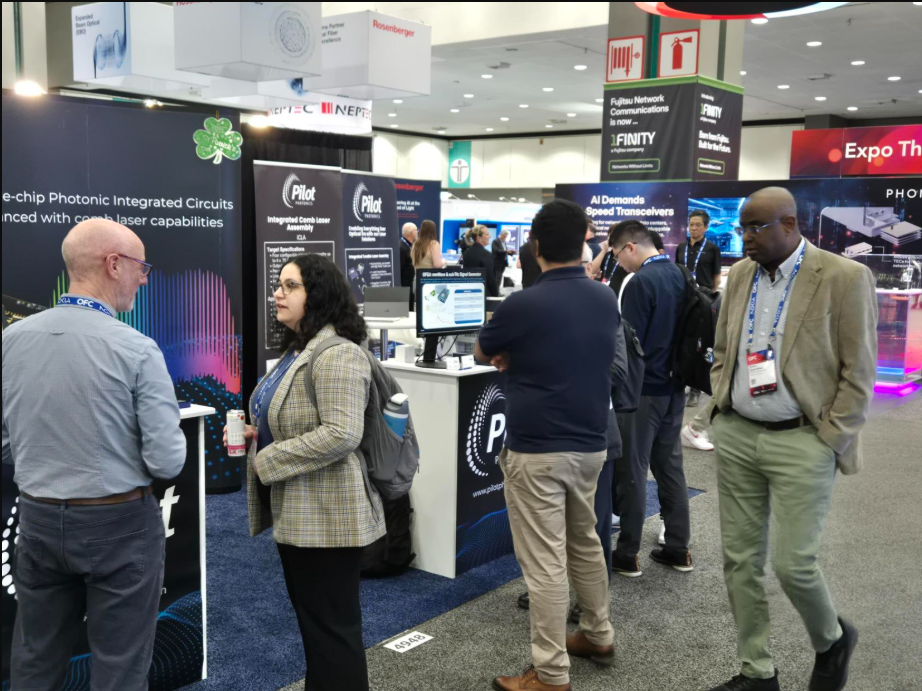
CTO Frank Smyth and colleagues were at Los Angeles last week to attend and exhibit at Optical Fiber Communication Conference (OFC). Here are his thoughts and analysis of the latest market innovations in datacenters. By now I have had a chance to take stock and gather my thoughts post-OFC. Last year was all momentum and excitement around AI-driven demand. This year, that demand was still there, likely even stronger, but there was also a shift in tone. People were starting to worry about supply chains, capacity, and the industry’s ability to meet the demand. That worry is also a motivator. As two of the largest suppliers in the industry see huge investment from Nvidia to secure capacity, it creates an opportunity for smaller players like Pilot Photonics to have an impact. A Billion Optical Links A Year The scale being discussed is extraordinary. As the industry moves from the 51.2T to 102T switches, and as optics starts to move into the scale-up portion of the network, Andy Bechtolsheim noted “whatever number you are thinking of, it isn’t high enough.” He also did give a number: there soon may be demand for a billion optical links annually, and that is a huge increase over what the industry currently delivers. At the Optica Executive Forum, a huge theme was the emergence of “scale-across” networking as a major category. There are some differences in definition across the major players, but generally it refers to the neworking of AI datacentres across geographically distributed sites. This is necessary, because there simply isn’t enough power and resources available to locate them all at a single site. Last year I highlighted the Meta Hyperion datacentre, which is a 5GW beast with a footprint nearly the size of Manhattan. Scale-across is akin to DCI for traditional cloud datacentre networks, but with additional AI-specific network constraints around latency, traffic patterns, and so on. Coherent, coherent-lite, and IM/DD are all expected to feature in the scale-across segment depending on reach, power, and cost requirements. In the scale-out domain, the XPO MSA was probably the most significant announcement. A 12.8 Tbps, 64-channel (up to 200G/lane) pluggable with integrated liquid cooling up to around 400W, it is designed to prolong the reign of pluggable optics. It targets two constraints that have been pushing the industry toward co-packaged optics: power density and thermal management. While some of the biggest and most vertically integrated players will continue the march towards CPO, XPO may shift the timeline and slow down the transition away from pluggables for others. With 4X the density of OSFP pluggables, it is an impressive feat and maintains the operational advantages of pluggables in terms of serviceability and ecosystem. New Standards, Newer Challenges There were two further MSAs announced: Optical Compute Interconnect, which focussed on Optical I/O-type board and package level connectivity in the scale-up, and Open CPX, which aims to standardise CPO-type archiectures in the scale-out. Furthermore, the Advanced Photonics Coalition (APC) is growing in parallel and it plays a similar role at a different layer. APC is focused on CPO but from a supply chain and manufacturing perspective. We are one of the most recent members, along with Microsoft and Lightium. An open question is what happens as workloads become more dynamic. Inference and agentic AI introduces a very different traffic profile: more bursty, less predictable, more fragmented. Optical circuit switching, another huge theme this year, today operates at fibre-level granularity with relatively slow reconfiguration, which makes it powerful but not agile enough to fully support these types of flows and extract maximum efficiency from underutilised XPUs. A faster and more granular level of optical switching will likely emerge to complement today’s OCS, and there are several players emerging in this space. Finchetto is one we are particularly excited about, since they have chosen to develop their optical switch with our nano-second tunable laser. Another theme that came up repeatedly in conversations was the need for O-band tunable lasers to support the AI datacentre market boom, both through test & measurement and now, more and more, for network monitoring. C-band is the traditional choice for telecom, and as datacentre networks become larger, more complex, and demand higher reliability, monitoring starts to matter more. That naturally drives demand for agile tunable lasers in the O-band. No Better Environment For Innovation It is an exciting time. Opportunities are all around as more advanced laser sources are needed to enable the Everything over Optical era. As always, OFC was both hugely exciting and tiring – particularly with the 15 minute walk between the halls! In one evening, there was an EPIC networking event, another by PhotonDelta, the OFC rock concert, and an investors event at a craft brewery. It is nice to now be able to take stock, absorb the latest information and trends, double down on existing opportunities, and position for newly emerging ones. What’s more, we found where the best pint of Guinness can be had in LA. Damian spent a lot of time researching this, and it was St Patrick’s day, so luck was on our side. It was as good a pint as you could get back home. Well, just about. Drop by The Liberties of Dublin bar. Tell them Pilot sent you.
AI Datacentre the size of a city?

Now that the dust has settled after OFC here are some of our thoughts and take-aways: Co-packaged Optics Breaks Through In the lead-up to OFC 2025, the tone was set at Nvidia GTC when CEO Jensen Huang heralded their co-packaged optics (CPO) solution for scale out networking, announcing: “AI factories are a new class of data centers with extreme scale, and networking infrastructure must be reinvented to keep pace. By integrating silicon photonics directly into switches, NVIDIA is shattering the old limitations of hyperscale and enterprise networks…”. Although Broadcom, Ranovus and others had been making superb progress on CPO for several years, the Nvidia-factor brought it mainstream and created a notable buzz and hype around OFC. It was the largest OFC in more than 20 years with talk of renewed interest from investors and an increase in attendance. There certainly seemed to be a greater footfall, although it’s unclear whether the huge crowds and 90 minute queues on the opening morning were due to sheer numbers, or whether they were the result (ironically) of internet connectivity and technology issues! City Scale AI Datacentres At the Optica Executive Forum the keynote speaker from Google, Amin Vahdat, gave a fascinating talk about the past, present and future of AI networking. There was a ‘shivers down the spine’ moment as he likened it to being present at the dawn of the internet and the launch of the first browser sitting on the world wide web. It is, without doubt, exciting and exhilarating, and it is a privilege to be contributing in some small way to this revolution. We heard about Meta’s plan for a 2 gigawatt AI Factory that would cover the same area as much of Manhattan! And this is just one such project. Whilst AI developments are incontrovertibly moving forward at pace, and offer huge potential, could there be parallels with the bubble 25 years ago when the ‘new era’ of the world wide web resulted in overbuild of infrastructure coupled with over-inflated valuations? While we’re not there yet, a little bit of caution does seem warranted. Key Highlights from Pilot Photonics’ OFC 2025: Overall it was an OFC buzzing with anticipation and excitement: let’s keep the momentum going. 💡
Shining A Spotlight On…Mahrokh Avazpour

Welcome to the first of our ‘Shining a Spotlight on…’ blogs as we introduce you to our team. This blog features postdoctoral intern, Mahrokh Avazpour, as she reaches the end of her secondment and reflects on her time at Pilot. Where’s home to you? I’m originally from Iran, and that’s where my family still live. My life has taken me on an incredible journey—a Master’s degree in India, three years as a research assistant in Malaysia, a PhD in University of Puebla, Mexico, and Postdoc in Dublin City University, Ireland. This international experience has shaped me profoundly, and home is less a place and more a feeling—a sense of comfort, connection, and support – woven from the places I’ve lived and the people I cherish. Currently, Ireland feels closest to that sense of home, particularly because of the welcoming atmosphere and vibrant cultural scene. I’m not quite sure where I’ll end up, but the journey so far has been extraordinary. When did you join Pilot? I joined Pilot on a post-doctoral secondment in November 2024. That’s coming to an end at the end of February 2025. What projects do you work on at Pilot, and where does your work fit in to the company’s operations? At Pilot, my work focuses on SiN micro-resonators for generating optical frequency combs. During my PhD, I worked on designing and characterizing optical fiber loop modulation and pulse characterization. After completing my PhD at Dublin City University, I began working on actively mode-locked fiber lasers to generate optical combs, where polarization instability was a significant challenge. My current work at Pilot on micro-ring resonators aligns well with my background and expertise in optical frequency comb generation. What does a typical day look like for you? As I am here for a short period as part of my postdoctoral secondment, I work closely with the photonic engineers. Typically, I follow the schedule set by the group’s senior photonic engineer, who is currently leading the project I’m working on. We spend much of the day in the lab, and carry out a range of experiments and investigations with a view to identifying and selecting the most suitable resonators, stabilising them in optical packages and further integrating them into our hardware platforms. This hands-on work allows me to contribute directly to the project while gaining valuable experience in photonic integration and experimental techniques. What excites you about what we do at Pilot? What excites me most about Pilot is the cutting-edge research and innovation in photonics. The opportunity to work on micro-resonators for optical frequency comb generation aligns perfectly with my expertise and interests. I am particularly fascinated by the practical applications of this technology in fields such as telecommunications, and space. Additionally, there is an excellent collaborative environment at Pilot, where the team works together to push the boundaries of photonics, makes it an inspiring place to contribute and grow. The hands-on experience in the lab, coupled with the chance to solve real-world challenges, fuels my passion for advancing optical technologies. What does a successful day look like? A successful day is one where I make meaningful progress for my project and for the company. This could be through troubleshooting technical challenges, gaining new insights, or reaching new conclusions that can feed decision making and achieving successful project/product outcomes. Collaboration is also a key part of a successful day—productive discussions, learning from experienced photonic engineers, and sharing findings that help drive the project forward. What challenges do you experience? There are regular challenges that present themselves when trying to push the state of the art, particularly in a small company. There are a lot of demands on the team and resources to meet important customer and project deadlines. Sometimes this can impact my project. However, these challenges, and working in such a fast-paced environment, are also part of the learning process so overcoming them and reaching the goals brings a strong sense of accomplishment. What do you particularly enjoy about being part of the Pilot team? Being part of the Pilot team is a highly rewarding experience. I particularly enjoy the collaborative and innovative environment, where I get to work alongside skilled photonic engineers and researchers who are passionate about advancing optical technologies. The opportunity to engage in hands-on experiments and tackle real-world challenges in photonics is both exciting and intellectually stimulating. I also appreciate the supportive atmosphere within the team. There is a strong culture of knowledge sharing, where I can learn from experienced colleagues while also contributing my own expertise. The diversity of ideas and problem-solving approaches, which I see frequently in meetings where we discuss various challenges, makes each day interesting and helps me grow both professionally and technically. Furthermore, the access to advanced laboratory facilities and cutting-edge research tools allows me to deepen my understanding of photonic integration and optical frequency comb generation. This is my first experience of working in industry rather than academia and, although my time here has been short, it has been a valuable experience. I hope to have the opportunity to join industry full-time in the near future. Overall, being part of the Pilot team provides an inspiring and dynamic environment that fosters continuous learning and development. How do you enjoy your time when you’re not at work? Exploring scenic places helps me clear my mind and recharge my batteries, so when I’m not at work, I spend time outdoors; going for walks along the beach or in nature. Friends and family are important to me, and I like socializing, so you’ll often find me hosting barbecues, singing, or engaging in traditional Persian dancing. It’s been an absolute pleasure having you working with us, Mahrokh. You have been an important asset to the team with your thorough approach to investigation and testing, and your analytical skills. We’ll miss you when your secondment comes to an end, and we wish you all the best with your next steps.
Enabling the Next Generation of Space Communication, Observation and Science
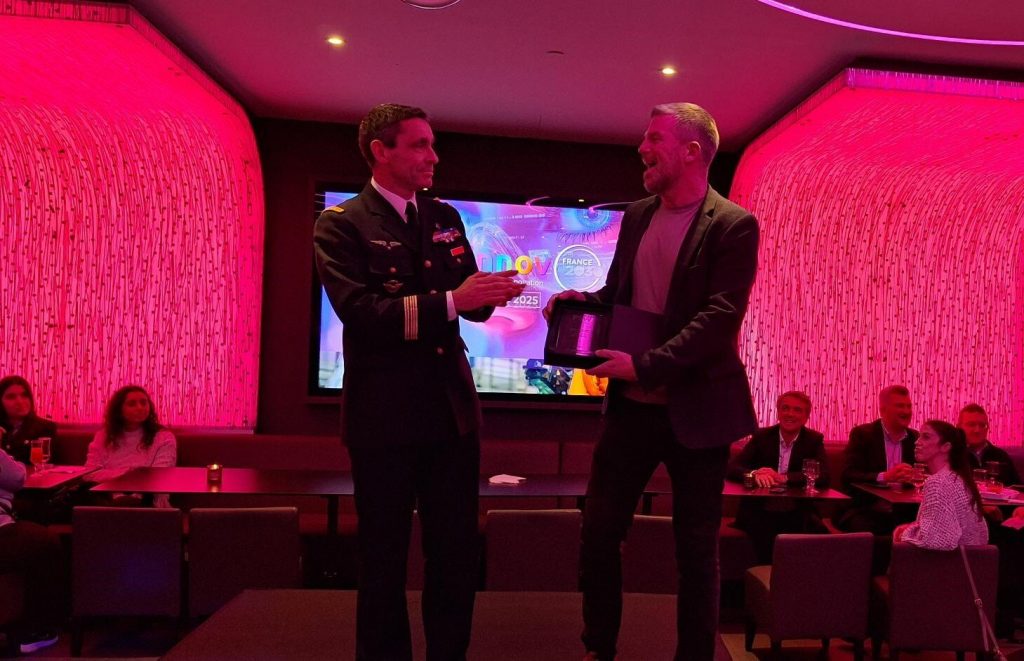
In February 2025 Pilot Photonics attended the Paris Space Week for the first time, exhibiting as part of the Irish Pavilion. Our application to participate in the PSW Innovation Challenge was accepted, and CTO and Co-Founder of Pilot, Frank Smyth delivered a presentation entitled ‘Astro-FGTM: Agile Optical Frequency Generator’ to a panel of judges. At the awards ceremony later the same day, we learnt that we had won the Innovation Challenge, with an award presented by Colonel Noël Farnaud. Needless to say, we’re thrilled and proud to receive this recognition of our innovation in space communications, observation and science. Pilot Photonics’ Co-Founder and CTO being presented with the PSW Innovation Challenge Award by Colonel Noël Farnaud from the French Space Command What was significant about what we said? Read on… The next generation of advanced space applications will demand for higher frequency components – needed for faster data rates and more precise measurements. Traditional electronic approaches struggle to provide the frequencies, bandwidth and noise performance required within an acceptable cost, size, weight and power envelope. So new innovations are needed. The Limitations and Hurdles: Pilot Photonics’ breakthrough is in being able to generate microwave, mmWave and sub-THz frequencies on its ASTRO-FGTM platform by leveraging the optical domain and photonic integration. Optical frequencies are roughly 10,000 times higher than the GHz range we typically use in microwave electronics. This breakthrough combines our optical frequency comb technology, with state-of-the-art photonic integration and advanced semiconductor packaging. Comb lasers are known to bridge the microwave and optical worlds, but how does the ASTRO-FGTM work? We integrate several key functions onto a tiny photonic integrated circuit. First, we apply a low frequency RF signal to the on-chip laser using a technique called gain switching – this generates a comb of optical frequencies spaced precisely by the applied RF frequency. Any two of these optical frequencies can then be selected using an on-chip active optical filter and applied to a high-speed photodetector. This enables us to produce highly stable, low phase noise carriers at the separation frequency of the selected optical carriers which can be anything from 4GHz to 250GHz. In this way we can achieve up to 50X multiplication in a single stage in contrast to electronic methods that typically offer 2 or 3X per stage. mmWave technology enables cutting edge communication, sensing and imaging, whilst photonic approaches enable precise, widely tunable signals in compact, lightweight, power efficient packages – essential when being integrated into payloads where minimising weight is critical. In addition, mmWaves are both EMI and radiation tolerant: hugely beneficial features when working with space applications. Advantages: The world’s first wide range and tunable optical frequency generation and conversion unit (OFGCU), Pilot’s ASTRO-FGTM has a number of advantages: Ultra-Wide Frequency Range: Performance and SWaP: Optical Domain: Future-Proof Platform: Key Applications: The key application areas for Astro-FGTM include: Next Steps: The next step for the ASTRO-FGTM is design-in for next generation space payloads, for which we are looking to partner with integrators and space primes. If this technology is of interest, or you would like to find out more please contact us on: sales@pilotphotonics.com