
OFC 2026: Headwinds Are Good For Takeoff
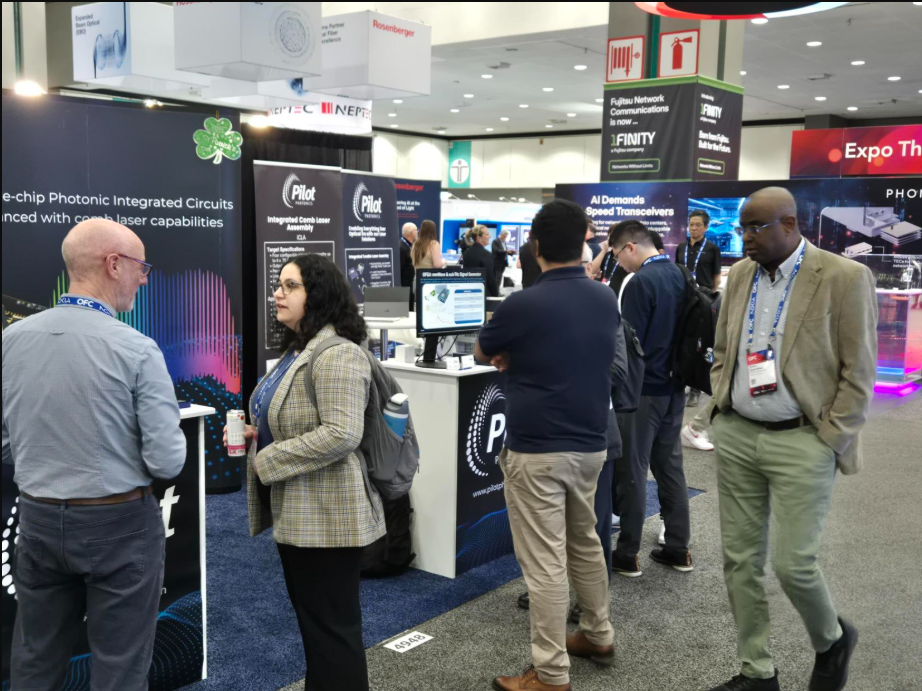
CTO Frank Smyth and colleagues were at Los Angeles last week to attend and exhibit at Optical Fiber Communication Conference (OFC). Here are his thoughts and analysis of the latest market innovations in datacenters. By now I have had a chance to take stock and gather my thoughts post-OFC. Last year was all momentum and excitement around AI-driven demand. This year, that demand was still there, likely even stronger, but there was also a shift in tone. People were starting to worry about supply chains, capacity, and the industry’s ability to meet the demand. That worry is also a motivator. As two of the largest suppliers in the industry see huge investment from Nvidia to secure capacity, it creates an opportunity for smaller players like Pilot Photonics to have an impact. A Billion Optical Links A Year The scale being discussed is extraordinary. As the industry moves from the 51.2T to 102T switches, and as optics starts to move into the scale-up portion of the network, Andy Bechtolsheim noted “whatever number you are thinking of, it isn’t high enough.” He also did give a number: there soon may be demand for a billion optical links annually, and that is a huge increase over what the industry currently delivers. At the Optica Executive Forum, a huge theme was the emergence of “scale-across” networking as a major category. There are some differences in definition across the major players, but generally it refers to the neworking of AI datacentres across geographically distributed sites. This is necessary, because there simply isn’t enough power and resources available to locate them all at a single site. Last year I highlighted the Meta Hyperion datacentre, which is a 5GW beast with a footprint nearly the size of Manhattan. Scale-across is akin to DCI for traditional cloud datacentre networks, but with additional AI-specific network constraints around latency, traffic patterns, and so on. Coherent, coherent-lite, and IM/DD are all expected to feature in the scale-across segment depending on reach, power, and cost requirements. In the scale-out domain, the XPO MSA was probably the most significant announcement. A 12.8 Tbps, 64-channel (up to 200G/lane) pluggable with integrated liquid cooling up to around 400W, it is designed to prolong the reign of pluggable optics. It targets two constraints that have been pushing the industry toward co-packaged optics: power density and thermal management. While some of the biggest and most vertically integrated players will continue the march towards CPO, XPO may shift the timeline and slow down the transition away from pluggables for others. With 4X the density of OSFP pluggables, it is an impressive feat and maintains the operational advantages of pluggables in terms of serviceability and ecosystem. New Standards, Newer Challenges There were two further MSAs announced: Optical Compute Interconnect, which focussed on Optical I/O-type board and package level connectivity in the scale-up, and Open CPX, which aims to standardise CPO-type archiectures in the scale-out. Furthermore, the Advanced Photonics Coalition (APC) is growing in parallel and it plays a similar role at a different layer. APC is focused on CPO but from a supply chain and manufacturing perspective. We are one of the most recent members, along with Microsoft and Lightium. An open question is what happens as workloads become more dynamic. Inference and agentic AI introduces a very different traffic profile: more bursty, less predictable, more fragmented. Optical circuit switching, another huge theme this year, today operates at fibre-level granularity with relatively slow reconfiguration, which makes it powerful but not agile enough to fully support these types of flows and extract maximum efficiency from underutilised XPUs. A faster and more granular level of optical switching will likely emerge to complement today’s OCS, and there are several players emerging in this space. Finchetto is one we are particularly excited about, since they have chosen to develop their optical switch with our nano-second tunable laser. Another theme that came up repeatedly in conversations was the need for O-band tunable lasers to support the AI datacentre market boom, both through test & measurement and now, more and more, for network monitoring. C-band is the traditional choice for telecom, and as datacentre networks become larger, more complex, and demand higher reliability, monitoring starts to matter more. That naturally drives demand for agile tunable lasers in the O-band. No Better Environment For Innovation It is an exciting time. Opportunities are all around as more advanced laser sources are needed to enable the Everything over Optical era. As always, OFC was both hugely exciting and tiring – particularly with the 15 minute walk between the halls! In one evening, there was an EPIC networking event, another by PhotonDelta, the OFC rock concert, and an investors event at a craft brewery. It is nice to now be able to take stock, absorb the latest information and trends, double down on existing opportunities, and position for newly emerging ones. What’s more, we found where the best pint of Guinness can be had in LA. Damian spent a lot of time researching this, and it was St Patrick’s day, so luck was on our side. It was as good a pint as you could get back home. Well, just about. Drop by The Liberties of Dublin bar. Tell them Pilot sent you.
ECOC 2022: PILOT USES JePPIX SERVER FOR PHOTONICS TECH
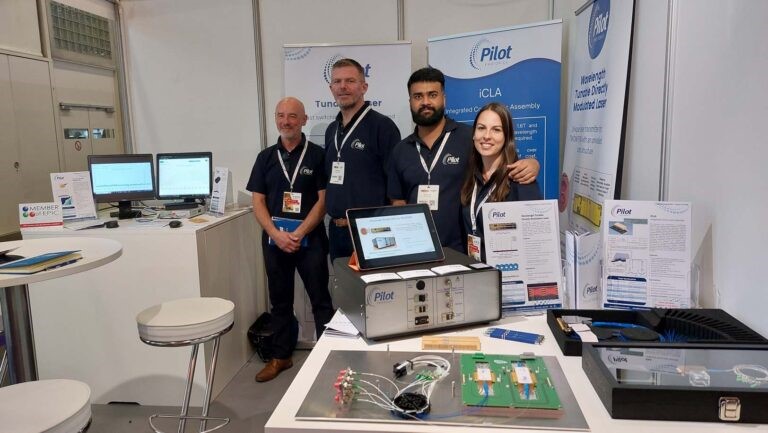
Pilot Photonics demonstrated three new products at ECOC2022 which emanated from the JePPIX platform. These include a low linewidth fast tuneable laser, an InP-based monolithic single mode laser in the C-band; an integrated Comb Laser Assembly (iCLA) for scaling coherent transceiver capacity, and SuperTROSA™ a comb-based superchannel transmitter. Low Linewidth Fast Tunable Laser has a tuning range of > 30nm centered at 1550 nm, with high side-mode suppression ratio. It offers linewidth < 150kHz and low power consumption. This laser is currently offered in a standard 14-pin butterfly package, with a thermo-electric cooler, internal isolators, and polarisation-maintaining fibre pigtail with FC/APC connectors. Development in a nano-iTLA formfactor is underway. The integrated comb laser assembly (iCLA) incorporates a monolithically integrated comb laser and demultiplexer that supplies four or more simultaneously generated coherent, phase matched outputs on separate fibres, replacing up to 4 integrated tuneable laser assemblies (iTLAs). It is designed for driving multiple 400G/800G coherent optical engines on individual fibres from a single laser module. This patented source technology offers the ability to tune the wavelength separation of the four outputs, while maintaining the coherent and phase-matched characteristics, reducing the required DSP complexity The TERA-4-TX is a transmit side optical engine for next-generation coherent superchannel transceivers. It combines a wavelength-tuneable, integrated comb source and demux that supply four simultaneously generated coherent wavelengths to an array of dual polarisation IQ modulators. “JePPIX has allowed us to offer PICS with enhanced performance and capability and enabled us to target new industry verticals,” says Frank Smyth, founder and chief technology officer of Pilot Photonics. Kevin Williams, Professor and chair of the Photonic Integration group at TU Eindhoven, a JePPIX partner, considers it “an excellent example of how an early-stage company can create new products that may route to production thanks to the JePPIX Pilot Line”. Source: Optical Connections
“MWP4SPACE” DOCTORAL TRAINING NETWORK FORMALLY COMMENCES
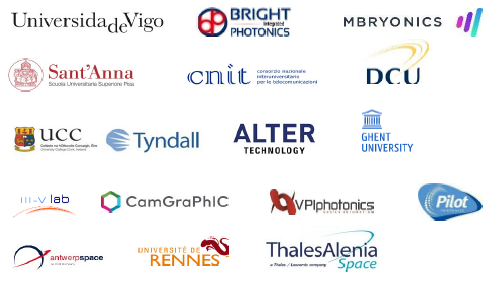
Pilot Photonics joined partners from around Europe to formally commence the EU-funded Doctoral Training Network entitled MicroWave Photonic Technologies for Communication and Sensing Applications in Space (MWP4SPACE).The MWP4SPACE project will train specialists in Integrated Microwave Photonic (IMWP) devices and systems in the framework of satellite and space applications. MWP4SPACE will offer an education program for 15 doctoral candidates structured in research projects and network‐wide training activities. Pilot Photonics is an associated partner in the training network which is formed by 6 European Universities, 1 non‐profit academic research institution and 9 companies that are world‐class references in both photonics and space technologies.