
Scaling up with PhotonHub
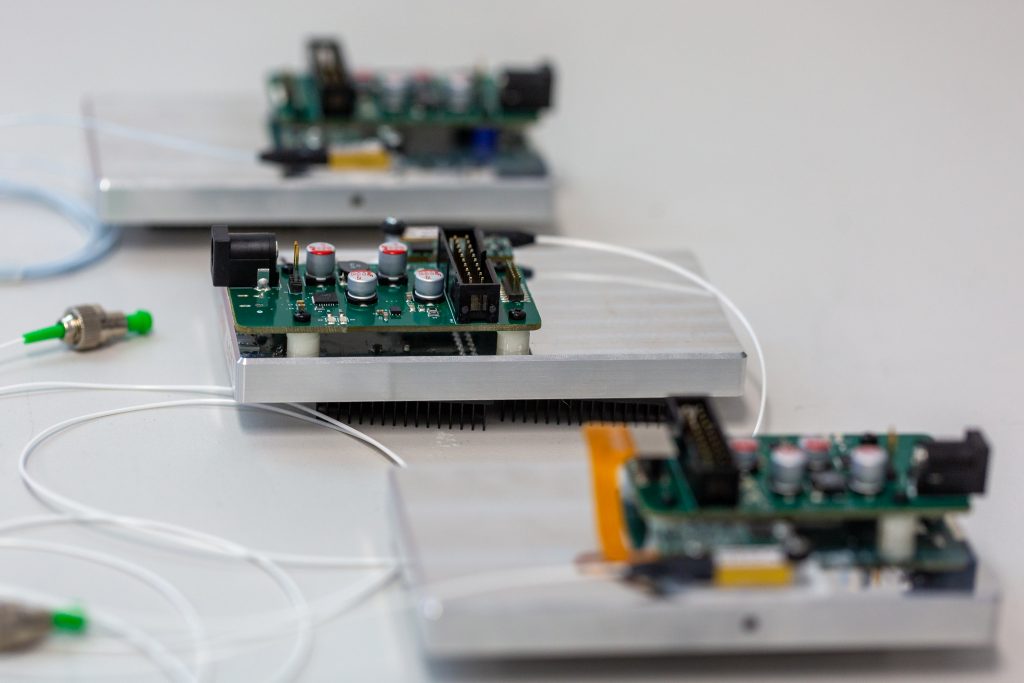
We recently wrapped up a couple of upscaling projects as we prepare our products for larger scale production. This is how we are preparing for volume! No matter the application, market, or the technology, every startup with a physical product reaches the same make or break stage: can the product scale? In our case, Pilot Photonics is leveraging the scalability of photonic chips to make optical solutions smaller, cheaper, and more power efficient. Still, photonic integrated circuit (PIC) devices go through many iterations in circuit design, process engineering, assembly optimisation, packaging approaches, and control algorithms. Projects like PhotonHub Europe, funded by the European Commission through the Horizon Europe programme, are designed to support product developers like Pilot through those development stages. We have just wrapped up a couple of scale-up projects to improve the Technology Readiness Levels (TRL) of two of our products. Our integrated comb laser assembly (iCLA) and our nano-integrated tuneable laser assembly (nano-iTLA), both based on monolithic indium phosphide PICs, have reached new levels of manufacturability thanks to our collaborations with Fraunhofer HHI and SMART Photonics. CLASSYCAL: Comb lasers for millimetre-wave generation The integrated comb laser assembly (iCLA) was initially designed for scaling coherent optical transceivers by delivering multiple coherent wavelengths from a single laser. As we continued developing it, it has received significant interest also for micro-wave and mmWave applications in space, test and measurement, and mobile telecommunications. Project CLASSYCAL was conducted in collaboration with Fraunhofer HHI. The goals of the project were deeper integration and miniaturisation, improved electronics, and better monitoring and control. This included the integration of high speed photodetectors, developed by HHI, for ultra-high speed operation, packaging refinements for improving the thermal performance and deeper integration for manufacturability. Embedded iCLA module produced during project CLASSYCAL We also improved the device’s post production phase. Burn-in protocols were developed to improve its stability. Along with that, we developed closed loop control algorithms, enabling customer field testing. This fed into an early evaluation unit for a variable optical frequency generator unit (OFGU), which we recently published a white paper on. We’re now at a stage where the new miniaturized form-factor is enabling more customer demonstrations and customer feedback is mapping the road ahead for the device development. The next phase will be a design for manufacture with a view to ramping up. NETTLESOUP: Tuneable lasers for high speed operation Our nano-integrated tuneable laser assembly (nano-iTLA) is geared towards optical communications, test & measurement, LiDAR, and coherent optical inter-satellite links. Its high speed tuneability in the nanosecond regime has received a lot of interest from AI data network innovators like Finchetto and satellite communication builders like MBRYONICS. There is continuous pull in our target markets for increased laser output power. This was one of our objectives in NETTLESOUP, along with improving yield, and manufacturability in pilot production runs. In collaboration with SMART Photonics, these targets were achieved. Nano-iTLA module produced during NETTLESOUP, with goldbox laser packaging and wrap-around electronics. On the manufacturability front, we tested out the use of tapered semiconductor optical amplifiers (SOA) to reduce gain saturation and avoid complicated processing, relying on SMART’s improved 4 inch process. Production was streamlined across the board, from mask creation to back-end processing with new benchmarks in time from tape-out to fab-out. With the monolithic integration of the SOAs and the testing out of design variations, we were able to achieve target power, and have seen 18 dBm ex-facet consistently. The tapered SOA also allowed extra feedback resilience, and design variations have made it clear that increasing the tuning range is also possible. What comes next for our integrated lasers Signals from the market have been consistently positive regarding our nano-iTLAs. This is why our primary occupation is making sure that our products can be repeatably manufactured in volume with the performance, yield and reliability demanded by our customers. We are producing and delivering evaluation and design-in modules and taking in all the feedback we’re getting. It is plenty of work for our small team, which is also why we are stoked about the funding we recently received via the European Innovation Council. We are planning on growing locally and internationally, and will accelerate our product work with every new colleague. Getting Pilot Photonics to this stage has taken a lot of work, funding, and building trust. Programmes like PhotonHub are instrumental in stimulating the European ecosystem, enabling small companies to bring innovative deep tech products to various markets. We are very proud of the progress we have been making, and look forward to sharing more project results with you in the near future!
ECOC 2022: PILOT USES JePPIX SERVER FOR PHOTONICS TECH
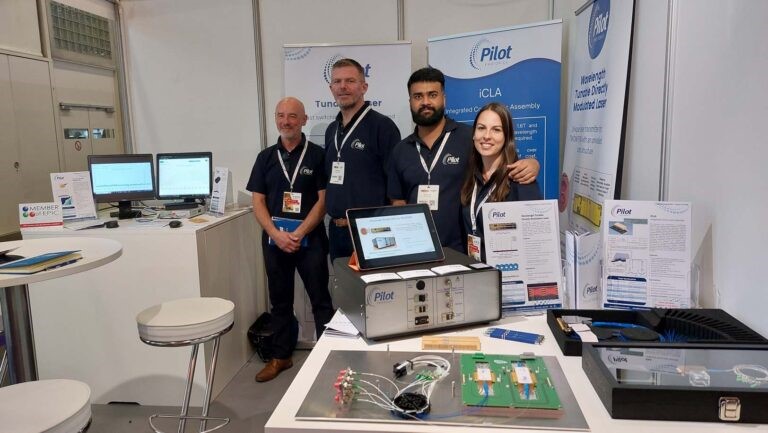
Pilot Photonics demonstrated three new products at ECOC2022 which emanated from the JePPIX platform. These include a low linewidth fast tuneable laser, an InP-based monolithic single mode laser in the C-band; an integrated Comb Laser Assembly (iCLA) for scaling coherent transceiver capacity, and SuperTROSA™ a comb-based superchannel transmitter. Low Linewidth Fast Tunable Laser has a tuning range of > 30nm centered at 1550 nm, with high side-mode suppression ratio. It offers linewidth < 150kHz and low power consumption. This laser is currently offered in a standard 14-pin butterfly package, with a thermo-electric cooler, internal isolators, and polarisation-maintaining fibre pigtail with FC/APC connectors. Development in a nano-iTLA formfactor is underway. The integrated comb laser assembly (iCLA) incorporates a monolithically integrated comb laser and demultiplexer that supplies four or more simultaneously generated coherent, phase matched outputs on separate fibres, replacing up to 4 integrated tuneable laser assemblies (iTLAs). It is designed for driving multiple 400G/800G coherent optical engines on individual fibres from a single laser module. This patented source technology offers the ability to tune the wavelength separation of the four outputs, while maintaining the coherent and phase-matched characteristics, reducing the required DSP complexity The TERA-4-TX is a transmit side optical engine for next-generation coherent superchannel transceivers. It combines a wavelength-tuneable, integrated comb source and demux that supply four simultaneously generated coherent wavelengths to an array of dual polarisation IQ modulators. “JePPIX has allowed us to offer PICS with enhanced performance and capability and enabled us to target new industry verticals,” says Frank Smyth, founder and chief technology officer of Pilot Photonics. Kevin Williams, Professor and chair of the Photonic Integration group at TU Eindhoven, a JePPIX partner, considers it “an excellent example of how an early-stage company can create new products that may route to production thanks to the JePPIX Pilot Line”. Source: Optical Connections
Pilot Photonics participated at ECOC 2022 in Basel

Pilot Photonics attended the European Conference on Optical Communication in Basel this September. The company took its largest trade show booth to date, and six members of the Pilot team demonstrated a number of new and existing products and technologies during a busy three days at the show. The products on display were Off the booth, Pilot Photonics’ CTO Dr. Frank Smyth presented a talk on Pilot’s integrated comb laser assembly (iCLA) at the Product Focus Session. The slides from the talk can be downloaded here [ LINK TO CONTENT].He also spoke about the same technology to the ECOC TV team, and that interview can be viewed below.