
AI Datacentre the size of a city?

Now that the dust has settled after OFC here are some of our thoughts and take-aways: Co-packaged Optics Breaks Through In the lead-up to OFC 2025, the tone was set at Nvidia GTC when CEO Jensen Huang heralded their co-packaged optics (CPO) solution for scale out networking, announcing: “AI factories are a new class of data centers with extreme scale, and networking infrastructure must be reinvented to keep pace. By integrating silicon photonics directly into switches, NVIDIA is shattering the old limitations of hyperscale and enterprise networks…”. Although Broadcom, Ranovus and others had been making superb progress on CPO for several years, the Nvidia-factor brought it mainstream and created a notable buzz and hype around OFC. It was the largest OFC in more than 20 years with talk of renewed interest from investors and an increase in attendance. There certainly seemed to be a greater footfall, although it’s unclear whether the huge crowds and 90 minute queues on the opening morning were due to sheer numbers, or whether they were the result (ironically) of internet connectivity and technology issues! City Scale AI Datacentres At the Optica Executive Forum the keynote speaker from Google, Amin Vahdat, gave a fascinating talk about the past, present and future of AI networking. There was a ‘shivers down the spine’ moment as he likened it to being present at the dawn of the internet and the launch of the first browser sitting on the world wide web. It is, without doubt, exciting and exhilarating, and it is a privilege to be contributing in some small way to this revolution. We heard about Meta’s plan for a 2 gigawatt AI Factory that would cover the same area as much of Manhattan! And this is just one such project. Whilst AI developments are incontrovertibly moving forward at pace, and offer huge potential, could there be parallels with the bubble 25 years ago when the ‘new era’ of the world wide web resulted in overbuild of infrastructure coupled with over-inflated valuations? While we’re not there yet, a little bit of caution does seem warranted. Key Highlights from Pilot Photonics’ OFC 2025: Overall it was an OFC buzzing with anticipation and excitement: let’s keep the momentum going. 💡
Enabling the Next Generation of Space Communication, Observation and Science
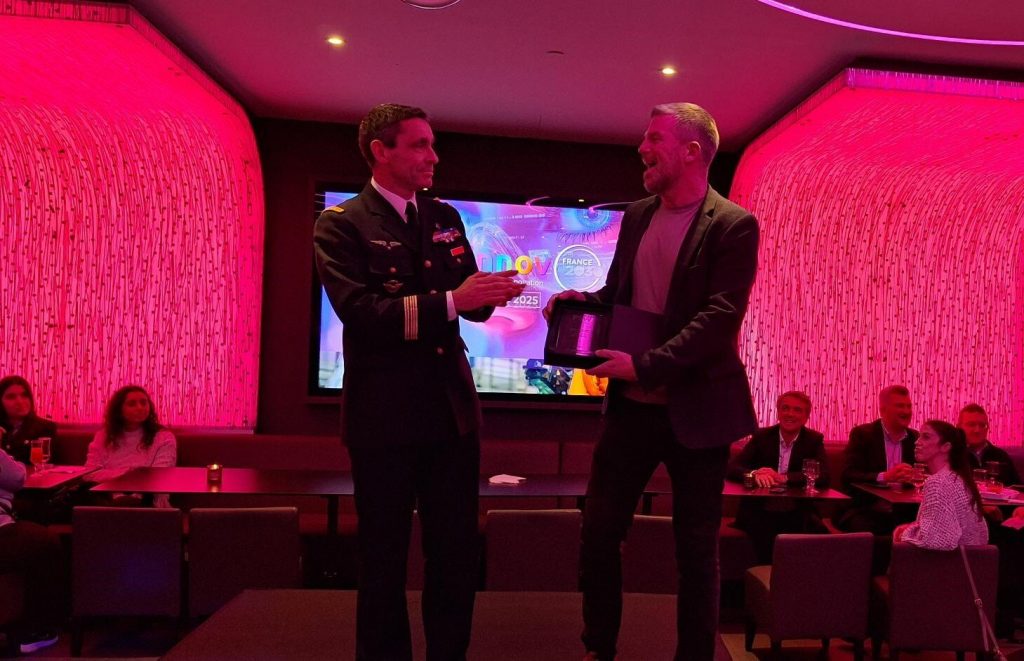
In February 2025 Pilot Photonics attended the Paris Space Week for the first time, exhibiting as part of the Irish Pavilion. Our application to participate in the PSW Innovation Challenge was accepted, and CTO and Co-Founder of Pilot, Frank Smyth delivered a presentation entitled ‘Astro-FGTM: Agile Optical Frequency Generator’ to a panel of judges. At the awards ceremony later the same day, we learnt that we had won the Innovation Challenge, with an award presented by Colonel Noël Farnaud. Needless to say, we’re thrilled and proud to receive this recognition of our innovation in space communications, observation and science. Pilot Photonics’ Co-Founder and CTO being presented with the PSW Innovation Challenge Award by Colonel Noël Farnaud from the French Space Command What was significant about what we said? Read on… The next generation of advanced space applications will demand for higher frequency components – needed for faster data rates and more precise measurements. Traditional electronic approaches struggle to provide the frequencies, bandwidth and noise performance required within an acceptable cost, size, weight and power envelope. So new innovations are needed. The Limitations and Hurdles: Pilot Photonics’ breakthrough is in being able to generate microwave, mmWave and sub-THz frequencies on its ASTRO-FGTM platform by leveraging the optical domain and photonic integration. Optical frequencies are roughly 10,000 times higher than the GHz range we typically use in microwave electronics. This breakthrough combines our optical frequency comb technology, with state-of-the-art photonic integration and advanced semiconductor packaging. Comb lasers are known to bridge the microwave and optical worlds, but how does the ASTRO-FGTM work? We integrate several key functions onto a tiny photonic integrated circuit. First, we apply a low frequency RF signal to the on-chip laser using a technique called gain switching – this generates a comb of optical frequencies spaced precisely by the applied RF frequency. Any two of these optical frequencies can then be selected using an on-chip active optical filter and applied to a high-speed photodetector. This enables us to produce highly stable, low phase noise carriers at the separation frequency of the selected optical carriers which can be anything from 4GHz to 250GHz. In this way we can achieve up to 50X multiplication in a single stage in contrast to electronic methods that typically offer 2 or 3X per stage. mmWave technology enables cutting edge communication, sensing and imaging, whilst photonic approaches enable precise, widely tunable signals in compact, lightweight, power efficient packages – essential when being integrated into payloads where minimising weight is critical. In addition, mmWaves are both EMI and radiation tolerant: hugely beneficial features when working with space applications. Advantages: The world’s first wide range and tunable optical frequency generation and conversion unit (OFGCU), Pilot’s ASTRO-FGTM has a number of advantages: Ultra-Wide Frequency Range: Performance and SWaP: Optical Domain: Future-Proof Platform: Key Applications: The key application areas for Astro-FGTM include: Next Steps: The next step for the ASTRO-FGTM is design-in for next generation space payloads, for which we are looking to partner with integrators and space primes. If this technology is of interest, or you would like to find out more please contact us on: sales@pilotphotonics.com