
OFC 2026: Headwinds Are Good For Takeoff
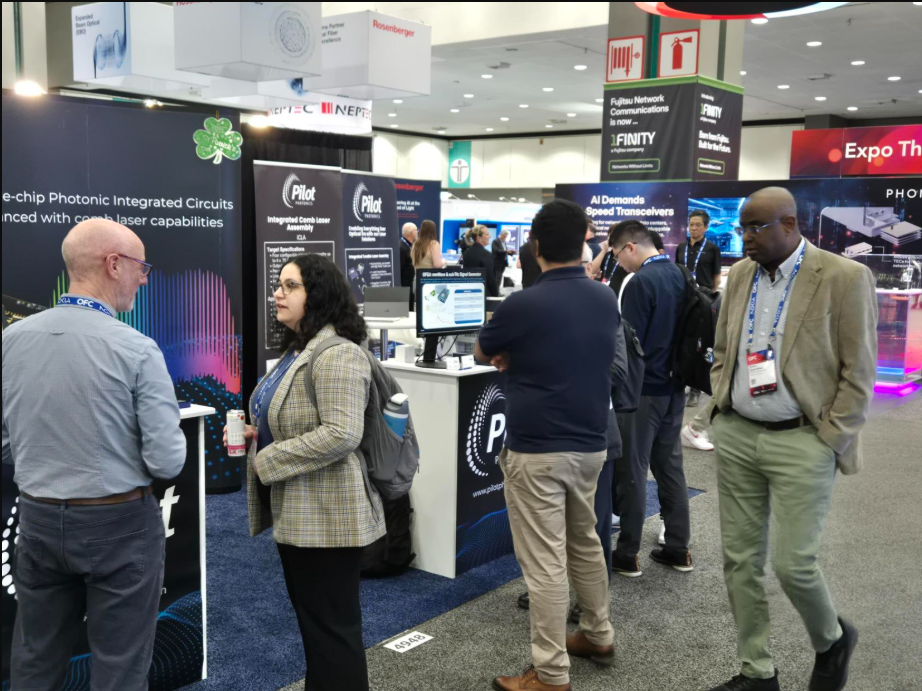
CTO Frank Smyth and colleagues were at Los Angeles last week to attend and exhibit at Optical Fiber Communication Conference (OFC). Here are his thoughts and analysis of the latest market innovations in datacenters. By now I have had a chance to take stock and gather my thoughts post-OFC. Last year was all momentum and excitement around AI-driven demand. This year, that demand was still there, likely even stronger, but there was also a shift in tone. People were starting to worry about supply chains, capacity, and the industry’s ability to meet the demand. That worry is also a motivator. As two of the largest suppliers in the industry see huge investment from Nvidia to secure capacity, it creates an opportunity for smaller players like Pilot Photonics to have an impact. A Billion Optical Links A Year The scale being discussed is extraordinary. As the industry moves from the 51.2T to 102T switches, and as optics starts to move into the scale-up portion of the network, Andy Bechtolsheim noted “whatever number you are thinking of, it isn’t high enough.” He also did give a number: there soon may be demand for a billion optical links annually, and that is a huge increase over what the industry currently delivers. At the Optica Executive Forum, a huge theme was the emergence of “scale-across” networking as a major category. There are some differences in definition across the major players, but generally it refers to the neworking of AI datacentres across geographically distributed sites. This is necessary, because there simply isn’t enough power and resources available to locate them all at a single site. Last year I highlighted the Meta Hyperion datacentre, which is a 5GW beast with a footprint nearly the size of Manhattan. Scale-across is akin to DCI for traditional cloud datacentre networks, but with additional AI-specific network constraints around latency, traffic patterns, and so on. Coherent, coherent-lite, and IM/DD are all expected to feature in the scale-across segment depending on reach, power, and cost requirements. In the scale-out domain, the XPO MSA was probably the most significant announcement. A 12.8 Tbps, 64-channel (up to 200G/lane) pluggable with integrated liquid cooling up to around 400W, it is designed to prolong the reign of pluggable optics. It targets two constraints that have been pushing the industry toward co-packaged optics: power density and thermal management. While some of the biggest and most vertically integrated players will continue the march towards CPO, XPO may shift the timeline and slow down the transition away from pluggables for others. With 4X the density of OSFP pluggables, it is an impressive feat and maintains the operational advantages of pluggables in terms of serviceability and ecosystem. New Standards, Newer Challenges There were two further MSAs announced: Optical Compute Interconnect, which focussed on Optical I/O-type board and package level connectivity in the scale-up, and Open CPX, which aims to standardise CPO-type archiectures in the scale-out. Furthermore, the Advanced Photonics Coalition (APC) is growing in parallel and it plays a similar role at a different layer. APC is focused on CPO but from a supply chain and manufacturing perspective. We are one of the most recent members, along with Microsoft and Lightium. An open question is what happens as workloads become more dynamic. Inference and agentic AI introduces a very different traffic profile: more bursty, less predictable, more fragmented. Optical circuit switching, another huge theme this year, today operates at fibre-level granularity with relatively slow reconfiguration, which makes it powerful but not agile enough to fully support these types of flows and extract maximum efficiency from underutilised XPUs. A faster and more granular level of optical switching will likely emerge to complement today’s OCS, and there are several players emerging in this space. Finchetto is one we are particularly excited about, since they have chosen to develop their optical switch with our nano-second tunable laser. Another theme that came up repeatedly in conversations was the need for O-band tunable lasers to support the AI datacentre market boom, both through test & measurement and now, more and more, for network monitoring. C-band is the traditional choice for telecom, and as datacentre networks become larger, more complex, and demand higher reliability, monitoring starts to matter more. That naturally drives demand for agile tunable lasers in the O-band. No Better Environment For Innovation It is an exciting time. Opportunities are all around as more advanced laser sources are needed to enable the Everything over Optical era. As always, OFC was both hugely exciting and tiring – particularly with the 15 minute walk between the halls! In one evening, there was an EPIC networking event, another by PhotonDelta, the OFC rock concert, and an investors event at a craft brewery. It is nice to now be able to take stock, absorb the latest information and trends, double down on existing opportunities, and position for newly emerging ones. What’s more, we found where the best pint of Guinness can be had in LA. Damian spent a lot of time researching this, and it was St Patrick’s day, so luck was on our side. It was as good a pint as you could get back home. Well, just about. Drop by The Liberties of Dublin bar. Tell them Pilot sent you.
Unlocking Optical Parallelism for the Everything Over Optical™ era

Pilot Photonics’ Hybrid Laser Breakthrough As the demand for AI acceleration, cloud computing, and disaggregated architectures intensifies, traditional copper interconnects are reaching physical limitations. At Pilot Photonics, we’re heralding the Everything over Optical™ era by addressing a critical bottleneck in data scaling: the need for high-power, multi-wavelength optical sources. The Copper Interconnect Bottleneck Copper interconnects are increasingly inadequate for supporting the exponential growth in bandwidth required by next-generation data centre architectures. At high data rates, the reach of copper interconnects fall dramatically, while the power needed to drive the signals increases substantially Optical interconnects, in contrast, offer: The need for change is evident: scalable, efficient, multi-terabit optical interconnects are essential for future connectivity. Bridging the Gap: From Scale-Out to Scale-Up We’ve already made the first leap — most modern data centres already rely on optical links such as CWDM4, PSM4, and DR4 to scale-out between racks and clusters, replacing copper in many mid-reach connections. But the next frontier is scale-up: bringing that same optical efficiency inside the system, between accelerators, memory pools, and compute tiles. Many of the longer links inside the data centre today use four wavelength coarse wavelength division multiplexing (CWDM4). However due to dispersion at high data rates, CWDM with its broad wavelength spacing does not scale well. To continue to meet escalating bandwidth demands, particularly in the scale-up segment, optical links must increase wavelength counts, from today’s common 4 wavelength links to 8, 16, or even higher. The industry is now converging on CW-WDM multi-source agreement, allowing denser channel spacing, as shown in the diagram below. Two primary approaches for the optical source are prevalent in this drive to higher channel count optical links: Laser arrays and comb lasers are each potential solutions to the copper interconnect bottleneck, but each have their own challenges and limitations A Hybrid Solution: ExCELS™ Pilot Photonics is developing a hybrid solution—ExCELS™ (External Comb-Enhanced Laser Source)—that combines the strengths of both approaches. By integrating a high-accuracy microcomb with a high-power laser array through optical injection locking, ExCELS™ delivers: Injection Locked Comb Demultiplexing for Enhanced Performance Our patented chip-scale micro-resonator combs, combined with integrated demultiplexing and amplification, enable a significant increase in comb line power and a substantial improvement in RIN compared to the traditional solution of a SiN comb with passive demultiplexing. This advancement translates to a capacity boost in high-performance applications such as co-packaged optics (CPO), optical I/O systems as well as traditional pluggable optics. Testing has shown greater than 3X capacity improvement, for the same received optical power. For CPO, the technology will be implemented in OIF-compliant External Laser Small Formfactor Pluggable (ELSFP), ensuring seamless integration into CPO infrastructure. Pilot’s solution delivers a significant improvement in RIN CW-WDM Product Portfolio Pilot Photonics is commercializing CW-WDM MSA focused products: Both platforms are flexible, customizable, and ready to support AI-scale networking, system prototyping, and future data centre deployments. Join us as we enable the Everything over Optical™ era.Contact us at sales@pilotphotonics.com
COCOPOP: Coherent Comb for Co-Packaged Optics for AI/ML Datacentres
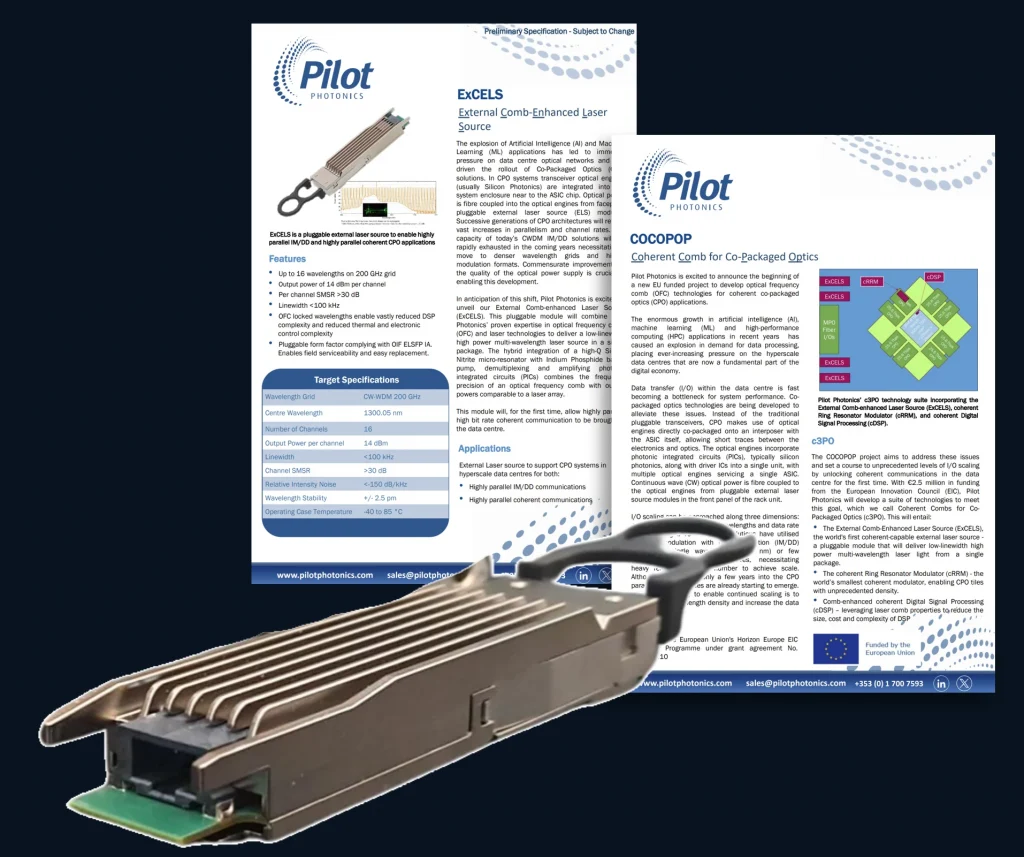
At Pilot Photonics, we are contributing to one of the key challenges in AI: How do we continue to scale datacentre capacity and processing power, while reducing the energy required. Backed by €2.5M in funding from the European Innovation Council’s HORIZON-EIC-2023-TRANSITION CHALLENGES programme, our project COCOPOP (Coherent Combs for Co-packaged Optics) is developing the world’s first comb-based External Laser Source (ELS). This isn’t just about more bandwidth — it’s about future-proofing the digital world. The Challenge: Scaling Optical Interconnects in AI and Cloud Data Centres The rapid growth of AI/ML, cloud computing, and data-intensive applications is pushing datacentres to their limits. Meeting these demands requires new levels of optical interconnect scalability. Today’s optical links inside datacentres typically rely on 1, 4, or 8 wavelengths, often using the CWDM4 grid. However, CWDM4, with its wider channel spacing and susceptibility to dispersion, doesn’t scale efficiently. To address the limitations of faceplate density, power consumption, and signal integrity, the industry is transitioning toward Co-Packaged Optics (CPO) and Optical I/O (OIO), architectures that place optics closer to the switch ASIC. This brings performance gains, but also introduces a new challenge: the laser sources at the heart of these systems must now meet stricter requirements for power, wavelength accuracy, and scalability. Laser arrays, commonly used in these systems, provide high per-channel power but struggle with wavelength accuracy and stability over time, which becomes critical as the number of wavelengths per fibre is scaled. Furthermore, scaling through fibre count is already reaching limits. When wavelengths per fiber, and number of fibers start to saturate, the remaining scaling axis is data rate per wavelength. Today’s systems rely on relatively simple Intensity Modulation / Direct Detection (IM/DD). Coherent communication, used today in longer optical links, enables data to be packed much more densely onto a channel. However, coherent is also more complex. It requires a stable, narrow-linewidth, laser at both the transmit side and the receive side and the wavelengths of each must be tightly aligned for successful communication. This is where simple laser arrays being proposed will struggle and this is the bottleneck that COCOPOP is working to eliminate. A 16 wavelength CPO system using laser arrays would need 32 lasers to be controlled and locked to each other in pairs. In contrast with a 16 wavelength comb laser on both sides, there is only one “tuning knob” required to bring-up all channels. By delivering a coherent-capable ELS based on chip-scale comb technology, COCOPOP addresses the critical need for scalable, stable, and high-performance light sources for today’s systems and also unlocks the next generation of datacentre capacity using coherent communication inside the datacentre. In our view, the question isn’t if the datacentre goes coherent, it’s when. And COCOPOP makes that possible. The COCOPOP Solution COCOPOP is developing the world’s first comb-based ELS. We call it ExCELS – External Comb-enhanced Laser Source – and it overcomes one of the key challenges that has plagued comb lasers to date: low power per wavelength. Integrating a chip-scale optical frequency comb to synchronise, lock and stabilise an integrated laser array, the architecture achieves the phase coherence and wavelength precision of a comb, while retaining the high power per wavelength and power efficiency of a laser array. Figure 1 – (Left) ExCELS Architecture comprising an optical frequency comb that injection-locks a laser array The result? More wavelengths, more power, tighter spacing (aligned with the CW-WDM MSA grid), higher wavelength accuracy and stability, lower noise and improved data throughput — all in a chip-scale and pluggable solution. Suitable for today’s high data-rate IM/DD but also unlocking the third scaling dimension by enabling coherent modulation and detection. Some of the key developments in the COCOPOP so far include: CW-WDM 16-Channel Laser Array Pilot Photonics has developed a 16-channel photonic integrated circuit, aligned to the CW-WDM MSA O-band grid with 200 GHz spacing. Originally designed as the injection-locked demultiplexer for the COCOPOP comb-based ELS, ExCELS, this PIC can also function as a standalone ELS for today’s IM/DD systems. Now part of Pilot Photonics’ commercial product portfolio, this PIC reinforces Pilot Photonics’ strategic role in shaping the CW-WDM ecosystem, further supported by the company’s recent membership in the CW-WDM MSA. Figure 2 – Laser array PIC and overlapped spectra of the 16 channels. Scalable SiN Comb Sources in C- and O-band COCOPOP has demonstrated optical frequency comb generation with two integrated photonic structures: a Silicon Nitride (SiN) micro-ring resonator and a SiN Bragg resonator comb. ExCELS ELSFP – A Comb-based ELS Figure 3 – ELSFP pluggable, and flyers for ExCELS Designed for pluggable form factors, ExCELS enables coherent-capable transmission inside data centres, aligning with the CW-WDM MSA and future-proofing AI and cloud-scale networks. A final architecture for the pluggable ExCELS was selected and two photonic integrated circuit (PIC) fabrication runs were completed: one in Silicon Nitride (SiN) for comb generation and one in Indium Phosphide (InP) for the demux laser array. An ELSFP-compliant housing has been sourced, and integration is underway. COCOPOP is just getting started, and the most exciting breakthroughs are yet to come. Stay tuned as we bring ExCELS to market and reshape the future of datacenter optics. Further information is available here: Optical Parallelism – Comb Lasers or Laser Arrays for Next-Generation Interconnects Gazettabyte – Home – A coherent roadmap for co-packaged optics COCOPOP Website