
Unlocking Optical Parallelism for the Everything Over Optical™ era

Pilot Photonics’ Hybrid Laser Breakthrough As the demand for AI acceleration, cloud computing, and disaggregated architectures intensifies, traditional copper interconnects are reaching physical limitations. At Pilot Photonics, we’re heralding the Everything over Optical™ era by addressing a critical bottleneck in data scaling: the need for high-power, multi-wavelength optical sources. The Copper Interconnect Bottleneck Copper interconnects are increasingly inadequate for supporting the exponential growth in bandwidth required by next-generation data centre architectures. At high data rates, the reach of copper interconnects fall dramatically, while the power needed to drive the signals increases substantially Optical interconnects, in contrast, offer: The need for change is evident: scalable, efficient, multi-terabit optical interconnects are essential for future connectivity. Bridging the Gap: From Scale-Out to Scale-Up We’ve already made the first leap — most modern data centres already rely on optical links such as CWDM4, PSM4, and DR4 to scale-out between racks and clusters, replacing copper in many mid-reach connections. But the next frontier is scale-up: bringing that same optical efficiency inside the system, between accelerators, memory pools, and compute tiles. Many of the longer links inside the data centre today use four wavelength coarse wavelength division multiplexing (CWDM4). However due to dispersion at high data rates, CWDM with its broad wavelength spacing does not scale well. To continue to meet escalating bandwidth demands, particularly in the scale-up segment, optical links must increase wavelength counts, from today’s common 4 wavelength links to 8, 16, or even higher. The industry is now converging on CW-WDM multi-source agreement, allowing denser channel spacing, as shown in the diagram below. Two primary approaches for the optical source are prevalent in this drive to higher channel count optical links: Laser arrays and comb lasers are each potential solutions to the copper interconnect bottleneck, but each have their own challenges and limitations A Hybrid Solution: ExCELS™ Pilot Photonics is developing a hybrid solution—ExCELS™ (External Comb-Enhanced Laser Source)—that combines the strengths of both approaches. By integrating a high-accuracy microcomb with a high-power laser array through optical injection locking, ExCELS™ delivers: Injection Locked Comb Demultiplexing for Enhanced Performance Our patented chip-scale micro-resonator combs, combined with integrated demultiplexing and amplification, enable a significant increase in comb line power and a substantial improvement in RIN compared to the traditional solution of a SiN comb with passive demultiplexing. This advancement translates to a capacity boost in high-performance applications such as co-packaged optics (CPO), optical I/O systems as well as traditional pluggable optics. Testing has shown greater than 3X capacity improvement, for the same received optical power. For CPO, the technology will be implemented in OIF-compliant External Laser Small Formfactor Pluggable (ELSFP), ensuring seamless integration into CPO infrastructure. Pilot’s solution delivers a significant improvement in RIN CW-WDM Product Portfolio Pilot Photonics is commercializing CW-WDM MSA focused products: Both platforms are flexible, customizable, and ready to support AI-scale networking, system prototyping, and future data centre deployments. Join us as we enable the Everything over Optical™ era.Contact us at sales@pilotphotonics.com
COCOPOP: Coherent Comb for Co-Packaged Optics for AI/ML Datacentres
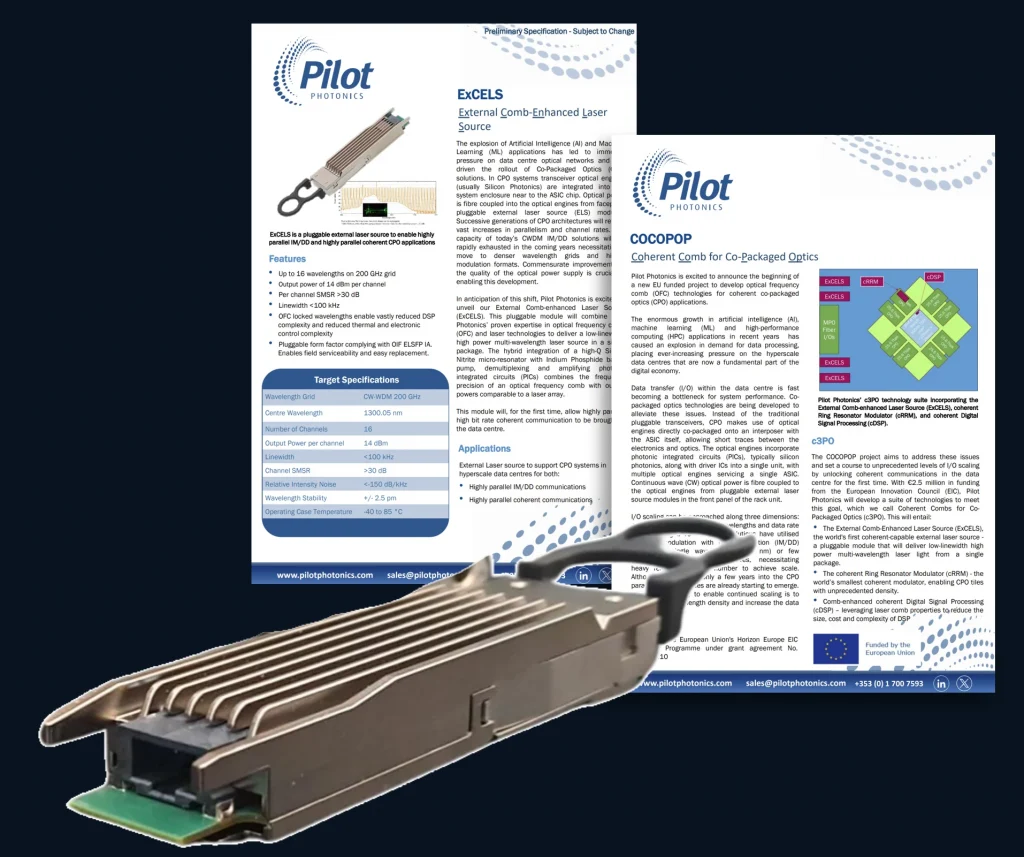
At Pilot Photonics, we are contributing to one of the key challenges in AI: How do we continue to scale datacentre capacity and processing power, while reducing the energy required. Backed by €2.5M in funding from the European Innovation Council’s HORIZON-EIC-2023-TRANSITION CHALLENGES programme, our project COCOPOP (Coherent Combs for Co-packaged Optics) is developing the world’s first comb-based External Laser Source (ELS). This isn’t just about more bandwidth — it’s about future-proofing the digital world. The Challenge: Scaling Optical Interconnects in AI and Cloud Data Centres The rapid growth of AI/ML, cloud computing, and data-intensive applications is pushing datacentres to their limits. Meeting these demands requires new levels of optical interconnect scalability. Today’s optical links inside datacentres typically rely on 1, 4, or 8 wavelengths, often using the CWDM4 grid. However, CWDM4, with its wider channel spacing and susceptibility to dispersion, doesn’t scale efficiently. To address the limitations of faceplate density, power consumption, and signal integrity, the industry is transitioning toward Co-Packaged Optics (CPO) and Optical I/O (OIO), architectures that place optics closer to the switch ASIC. This brings performance gains, but also introduces a new challenge: the laser sources at the heart of these systems must now meet stricter requirements for power, wavelength accuracy, and scalability. Laser arrays, commonly used in these systems, provide high per-channel power but struggle with wavelength accuracy and stability over time, which becomes critical as the number of wavelengths per fibre is scaled. Furthermore, scaling through fibre count is already reaching limits. When wavelengths per fiber, and number of fibers start to saturate, the remaining scaling axis is data rate per wavelength. Today’s systems rely on relatively simple Intensity Modulation / Direct Detection (IM/DD). Coherent communication, used today in longer optical links, enables data to be packed much more densely onto a channel. However, coherent is also more complex. It requires a stable, narrow-linewidth, laser at both the transmit side and the receive side and the wavelengths of each must be tightly aligned for successful communication. This is where simple laser arrays being proposed will struggle and this is the bottleneck that COCOPOP is working to eliminate. A 16 wavelength CPO system using laser arrays would need 32 lasers to be controlled and locked to each other in pairs. In contrast with a 16 wavelength comb laser on both sides, there is only one “tuning knob” required to bring-up all channels. By delivering a coherent-capable ELS based on chip-scale comb technology, COCOPOP addresses the critical need for scalable, stable, and high-performance light sources for today’s systems and also unlocks the next generation of datacentre capacity using coherent communication inside the datacentre. In our view, the question isn’t if the datacentre goes coherent, it’s when. And COCOPOP makes that possible. The COCOPOP Solution COCOPOP is developing the world’s first comb-based ELS. We call it ExCELS – External Comb-enhanced Laser Source – and it overcomes one of the key challenges that has plagued comb lasers to date: low power per wavelength. Integrating a chip-scale optical frequency comb to synchronise, lock and stabilise an integrated laser array, the architecture achieves the phase coherence and wavelength precision of a comb, while retaining the high power per wavelength and power efficiency of a laser array. Figure 1 – (Left) ExCELS Architecture comprising an optical frequency comb that injection-locks a laser array The result? More wavelengths, more power, tighter spacing (aligned with the CW-WDM MSA grid), higher wavelength accuracy and stability, lower noise and improved data throughput — all in a chip-scale and pluggable solution. Suitable for today’s high data-rate IM/DD but also unlocking the third scaling dimension by enabling coherent modulation and detection. Some of the key developments in the COCOPOP so far include: CW-WDM 16-Channel Laser Array Pilot Photonics has developed a 16-channel photonic integrated circuit, aligned to the CW-WDM MSA O-band grid with 200 GHz spacing. Originally designed as the injection-locked demultiplexer for the COCOPOP comb-based ELS, ExCELS, this PIC can also function as a standalone ELS for today’s IM/DD systems. Now part of Pilot Photonics’ commercial product portfolio, this PIC reinforces Pilot Photonics’ strategic role in shaping the CW-WDM ecosystem, further supported by the company’s recent membership in the CW-WDM MSA. Figure 2 – Laser array PIC and overlapped spectra of the 16 channels. Scalable SiN Comb Sources in C- and O-band COCOPOP has demonstrated optical frequency comb generation with two integrated photonic structures: a Silicon Nitride (SiN) micro-ring resonator and a SiN Bragg resonator comb. ExCELS ELSFP – A Comb-based ELS Figure 3 – ELSFP pluggable, and flyers for ExCELS Designed for pluggable form factors, ExCELS enables coherent-capable transmission inside data centres, aligning with the CW-WDM MSA and future-proofing AI and cloud-scale networks. A final architecture for the pluggable ExCELS was selected and two photonic integrated circuit (PIC) fabrication runs were completed: one in Silicon Nitride (SiN) for comb generation and one in Indium Phosphide (InP) for the demux laser array. An ELSFP-compliant housing has been sourced, and integration is underway. COCOPOP is just getting started, and the most exciting breakthroughs are yet to come. Stay tuned as we bring ExCELS to market and reshape the future of datacenter optics. Further information is available here: Optical Parallelism – Comb Lasers or Laser Arrays for Next-Generation Interconnects Gazettabyte – Home – A coherent roadmap for co-packaged optics COCOPOP Website
Optical Parallelism – Comb Lasers or Laser Arrays for Next-Generation Interconnects

I was delighted to be given the opportunity to speak at the ECOC Market Focus session this year, and to share the stage with some of the leaders of our industry, including Intel, Nvidia and Broadcom. In this blog, I wanted to share my talk on the subject of increasing optical parallelism, and to add in a few additional comments. To give some context, it’s worth exploring what we mean by increased optical parallelism, and what’s driving the need. Essentially, we are referring to techniques to overcome scalability limits in optical networks by adding more channels whether these are more wavelengths, or more fibers. The most well known example is probably DWDM, where multiple channels, each on a different wavelength, are added to a fiber link to increase the capacity. Currently, it’s getting harder to keep growing those single wavelength channels, so now multiple wavelengths are needed per channel. This is one example of increased optical parallelism. Similar scalability problems are presenting in numerous network segments. So what is driving the need? In the more traditional optical telecoms and cloud datacentre segments, there is continued exponential growth in data created, copied, and consumed, and it’s showing no sign of slowing down. Coupled with this is the fact that further significant growth in symbol rates is becoming increasingly harder to achieve, and this gives rise to the need for greater parallelism. The two images above illustrate these issues. Added to all this is the explosion of AI and machine learning, where large language models have grown at a rate of 10 times each year for the past 6 years. ChatGPT alone conducts 2.5 billion sessions per month via its website, excluding API calls, with each session averaging 8 minutes and consisting of many inferences. Lower data rates and simpler modulation and processing are used in order to meet this sector’s requirement for low latency and low power requirements so, to meet the colossal and concurrent demand for bandwidth, many, many channels are needed – again driving a need for increased parallelism. As mentioned, the primary opportunities for increasing parallelism exist through the introduction of more fibers or increasing the number of wavelengths per fiber. As a comb laser company, our focus is on the wavelength domain but such is the demand that it’s likely that both domains will need to be heavily exploited. The two primary options for increasing optical parallelism in the wavelength domain are: → laser arrays, and → comb lasers Expressed simply, a laser array consists of multiple lasers, each emitting a single, independent wavelength on an individual waveguide. These can range from an array of DFBs (either individual or on a single chip) to an array of iTLAs in a multi-wavelength transceiver. In comparison, a comb laser is a single laser emitting multiple, precisely spaced, phase coherent wavelengths on a single waveguide. Comb lasers exist in various forms, including mode locked laser diodes, Kerr micro-combs, and gain switched combs, each suitable for particular applications, and all with their own pros and cons. So what are the potential applications for comb lasers where greater parallelism is required? In my talk at ECOC, I simplified the myriad of transceiver and interconnect technologies into two broad categories: Coherent C-band exists as two main architectures: The challenge driving higher parallelism within coherent C-band is that symbol rate increases are getting harder to achieve, while component bandwidths are forcing changes to new materials. This drives a demand to higher wavelength counts, and we expect to see more 2- and 4- wavelength transceivers emerging – and possibly 8-wavelengths over time. The benefits of a comb laser in these systems include: In addition, the unique features of optical combs can be exploited to simplify the digital signal processing, enable non-linear impairment compensation, or to allow unique features such as receiver bandwidth slicing and transmitter channel stitching. IM/DD O-band can, again, be simplified into two large categories: The key demand for, and benefit of, optical combs in this intra-datacentre space is in relation to the densification of the wavelength grid. Today, many of these systems use CWDM4 – a 4-wavelength grid with particularly large (20nm) spacing between the lasers for the prevention of interference. The difficulty here is that dispersion precludes the addition of more wavelengths with this spacing, yet the industry needs more capacity and therefore more channels. This need has driven the CW-WDM multi-source agreement which defines significantly more dense wavelength grids of 800GHz, 400GHz, 200GHz, and 100GHz spacing in the O-band. Whilst traditional distributed feedback (DFB) arrays can readily achieve 800GHz and 400GHz, manufacturing tolerance and aging-related drift makes intensification of the wavelength grids at or below 200GHz very challenging. Conversely, comb lasers have a precisely defined wavelength spacing that cannot drift and it is this that makes them extremely attractive for this grid densification requirement. There are challenges with comb lasers too, chief amongst which is their optical power. Because the full optical power is shared across many wavelengths, it is challenging for combs to compete against laser arrays where each wavelength has the full laser power. Pilot Photonics has pioneered an approach that overcomes this limitation, and offers the best features of both comb laser and laser array. The result is an optical signal with the power per wavelength of a laser array, but with the stability, low linewidth and phase coherence of an optical comb. The architecture has been integrated into a monolithic Indium Phosphide (InP) chip and demonstrated in multi-wavelength coherent optical transmission systems. Each coherent wavelength can carry up to 60Gbaud DP-32QAM signals delivering more than 2 Terabits per second from a single InP laser chip and package. Now, thanks to the support of our European Innovation Council programme COCOPOP, we are also focusing on delivering a 16-wavelength version in the O-band for datacentre applications. Successful integration of this technology will enable the industry to satisfy bandwidth demands whilst simultaneously facilitating reductions in power requirements and size, the result of which will be increased data transfer and capability.