
Scaling up with PhotonHub
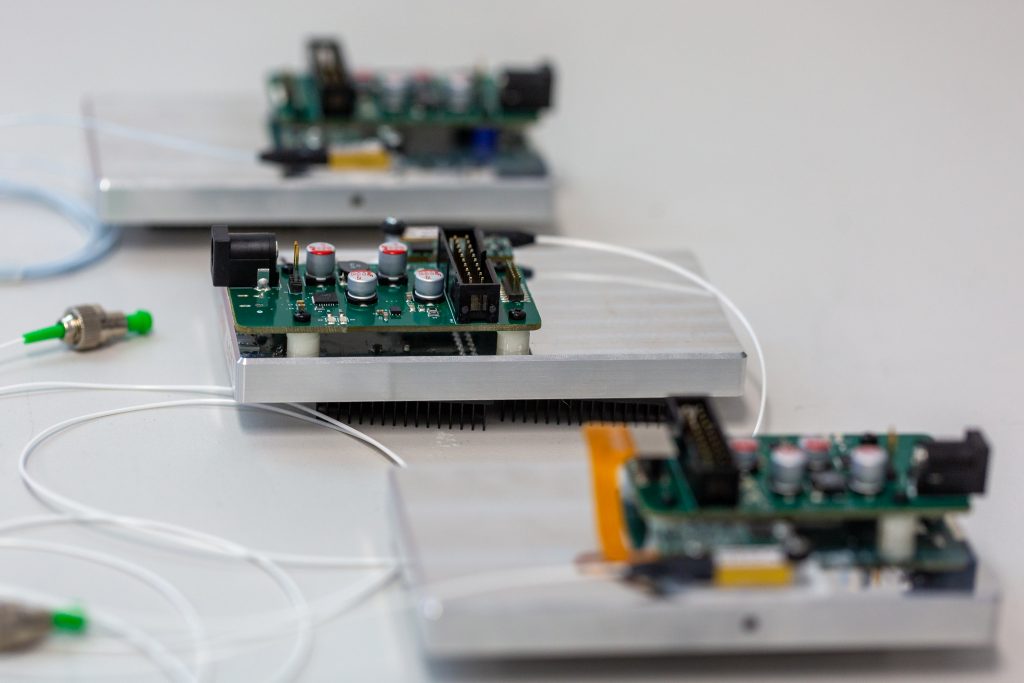
We recently wrapped up a couple of upscaling projects as we prepare our products for larger scale production. This is how we are preparing for volume! No matter the application, market, or the technology, every startup with a physical product reaches the same make or break stage: can the product scale? In our case, Pilot Photonics is leveraging the scalability of photonic chips to make optical solutions smaller, cheaper, and more power efficient. Still, photonic integrated circuit (PIC) devices go through many iterations in circuit design, process engineering, assembly optimisation, packaging approaches, and control algorithms. Projects like PhotonHub Europe, funded by the European Commission through the Horizon Europe programme, are designed to support product developers like Pilot through those development stages. We have just wrapped up a couple of scale-up projects to improve the Technology Readiness Levels (TRL) of two of our products. Our integrated comb laser assembly (iCLA) and our nano-integrated tuneable laser assembly (nano-iTLA), both based on monolithic indium phosphide PICs, have reached new levels of manufacturability thanks to our collaborations with Fraunhofer HHI and SMART Photonics. CLASSYCAL: Comb lasers for millimetre-wave generation The integrated comb laser assembly (iCLA) was initially designed for scaling coherent optical transceivers by delivering multiple coherent wavelengths from a single laser. As we continued developing it, it has received significant interest also for micro-wave and mmWave applications in space, test and measurement, and mobile telecommunications. Project CLASSYCAL was conducted in collaboration with Fraunhofer HHI. The goals of the project were deeper integration and miniaturisation, improved electronics, and better monitoring and control. This included the integration of high speed photodetectors, developed by HHI, for ultra-high speed operation, packaging refinements for improving the thermal performance and deeper integration for manufacturability. Embedded iCLA module produced during project CLASSYCAL We also improved the device’s post production phase. Burn-in protocols were developed to improve its stability. Along with that, we developed closed loop control algorithms, enabling customer field testing. This fed into an early evaluation unit for a variable optical frequency generator unit (OFGU), which we recently published a white paper on. We’re now at a stage where the new miniaturized form-factor is enabling more customer demonstrations and customer feedback is mapping the road ahead for the device development. The next phase will be a design for manufacture with a view to ramping up. NETTLESOUP: Tuneable lasers for high speed operation Our nano-integrated tuneable laser assembly (nano-iTLA) is geared towards optical communications, test & measurement, LiDAR, and coherent optical inter-satellite links. Its high speed tuneability in the nanosecond regime has received a lot of interest from AI data network innovators like Finchetto and satellite communication builders like MBRYONICS. There is continuous pull in our target markets for increased laser output power. This was one of our objectives in NETTLESOUP, along with improving yield, and manufacturability in pilot production runs. In collaboration with SMART Photonics, these targets were achieved. Nano-iTLA module produced during NETTLESOUP, with goldbox laser packaging and wrap-around electronics. On the manufacturability front, we tested out the use of tapered semiconductor optical amplifiers (SOA) to reduce gain saturation and avoid complicated processing, relying on SMART’s improved 4 inch process. Production was streamlined across the board, from mask creation to back-end processing with new benchmarks in time from tape-out to fab-out. With the monolithic integration of the SOAs and the testing out of design variations, we were able to achieve target power, and have seen 18 dBm ex-facet consistently. The tapered SOA also allowed extra feedback resilience, and design variations have made it clear that increasing the tuning range is also possible. What comes next for our integrated lasers Signals from the market have been consistently positive regarding our nano-iTLAs. This is why our primary occupation is making sure that our products can be repeatably manufactured in volume with the performance, yield and reliability demanded by our customers. We are producing and delivering evaluation and design-in modules and taking in all the feedback we’re getting. It is plenty of work for our small team, which is also why we are stoked about the funding we recently received via the European Innovation Council. We are planning on growing locally and internationally, and will accelerate our product work with every new colleague. Getting Pilot Photonics to this stage has taken a lot of work, funding, and building trust. Programmes like PhotonHub are instrumental in stimulating the European ecosystem, enabling small companies to bring innovative deep tech products to various markets. We are very proud of the progress we have been making, and look forward to sharing more project results with you in the near future!
OFC 2026: Headwinds Are Good For Takeoff
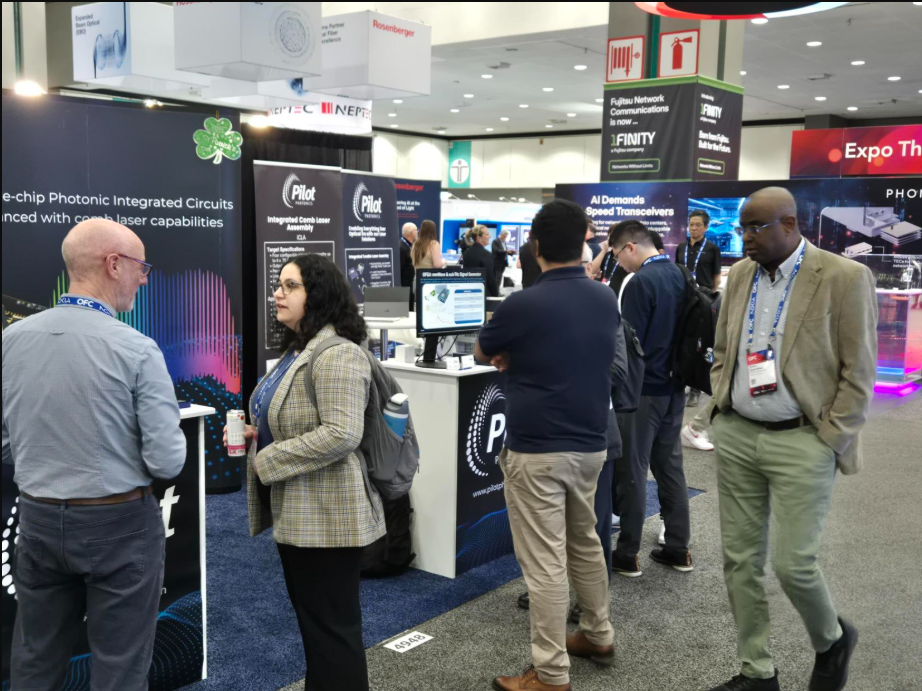
CTO Frank Smyth and colleagues were at Los Angeles last week to attend and exhibit at Optical Fiber Communication Conference (OFC). Here are his thoughts and analysis of the latest market innovations in datacenters. By now I have had a chance to take stock and gather my thoughts post-OFC. Last year was all momentum and excitement around AI-driven demand. This year, that demand was still there, likely even stronger, but there was also a shift in tone. People were starting to worry about supply chains, capacity, and the industry’s ability to meet the demand. That worry is also a motivator. As two of the largest suppliers in the industry see huge investment from Nvidia to secure capacity, it creates an opportunity for smaller players like Pilot Photonics to have an impact. A Billion Optical Links A Year The scale being discussed is extraordinary. As the industry moves from the 51.2T to 102T switches, and as optics starts to move into the scale-up portion of the network, Andy Bechtolsheim noted “whatever number you are thinking of, it isn’t high enough.” He also did give a number: there soon may be demand for a billion optical links annually, and that is a huge increase over what the industry currently delivers. At the Optica Executive Forum, a huge theme was the emergence of “scale-across” networking as a major category. There are some differences in definition across the major players, but generally it refers to the neworking of AI datacentres across geographically distributed sites. This is necessary, because there simply isn’t enough power and resources available to locate them all at a single site. Last year I highlighted the Meta Hyperion datacentre, which is a 5GW beast with a footprint nearly the size of Manhattan. Scale-across is akin to DCI for traditional cloud datacentre networks, but with additional AI-specific network constraints around latency, traffic patterns, and so on. Coherent, coherent-lite, and IM/DD are all expected to feature in the scale-across segment depending on reach, power, and cost requirements. In the scale-out domain, the XPO MSA was probably the most significant announcement. A 12.8 Tbps, 64-channel (up to 200G/lane) pluggable with integrated liquid cooling up to around 400W, it is designed to prolong the reign of pluggable optics. It targets two constraints that have been pushing the industry toward co-packaged optics: power density and thermal management. While some of the biggest and most vertically integrated players will continue the march towards CPO, XPO may shift the timeline and slow down the transition away from pluggables for others. With 4X the density of OSFP pluggables, it is an impressive feat and maintains the operational advantages of pluggables in terms of serviceability and ecosystem. New Standards, Newer Challenges There were two further MSAs announced: Optical Compute Interconnect, which focussed on Optical I/O-type board and package level connectivity in the scale-up, and Open CPX, which aims to standardise CPO-type archiectures in the scale-out. Furthermore, the Advanced Photonics Coalition (APC) is growing in parallel and it plays a similar role at a different layer. APC is focused on CPO but from a supply chain and manufacturing perspective. We are one of the most recent members, along with Microsoft and Lightium. An open question is what happens as workloads become more dynamic. Inference and agentic AI introduces a very different traffic profile: more bursty, less predictable, more fragmented. Optical circuit switching, another huge theme this year, today operates at fibre-level granularity with relatively slow reconfiguration, which makes it powerful but not agile enough to fully support these types of flows and extract maximum efficiency from underutilised XPUs. A faster and more granular level of optical switching will likely emerge to complement today’s OCS, and there are several players emerging in this space. Finchetto is one we are particularly excited about, since they have chosen to develop their optical switch with our nano-second tunable laser. Another theme that came up repeatedly in conversations was the need for O-band tunable lasers to support the AI datacentre market boom, both through test & measurement and now, more and more, for network monitoring. C-band is the traditional choice for telecom, and as datacentre networks become larger, more complex, and demand higher reliability, monitoring starts to matter more. That naturally drives demand for agile tunable lasers in the O-band. No Better Environment For Innovation It is an exciting time. Opportunities are all around as more advanced laser sources are needed to enable the Everything over Optical era. As always, OFC was both hugely exciting and tiring – particularly with the 15 minute walk between the halls! In one evening, there was an EPIC networking event, another by PhotonDelta, the OFC rock concert, and an investors event at a craft brewery. It is nice to now be able to take stock, absorb the latest information and trends, double down on existing opportunities, and position for newly emerging ones. What’s more, we found where the best pint of Guinness can be had in LA. Damian spent a lot of time researching this, and it was St Patrick’s day, so luck was on our side. It was as good a pint as you could get back home. Well, just about. Drop by The Liberties of Dublin bar. Tell them Pilot sent you.
Unlocking Optical Parallelism for the Everything Over Optical™ era

Pilot Photonics’ Hybrid Laser Breakthrough As the demand for AI acceleration, cloud computing, and disaggregated architectures intensifies, traditional copper interconnects are reaching physical limitations. At Pilot Photonics, we’re heralding the Everything over Optical™ era by addressing a critical bottleneck in data scaling: the need for high-power, multi-wavelength optical sources. The Copper Interconnect Bottleneck Copper interconnects are increasingly inadequate for supporting the exponential growth in bandwidth required by next-generation data centre architectures. At high data rates, the reach of copper interconnects fall dramatically, while the power needed to drive the signals increases substantially Optical interconnects, in contrast, offer: The need for change is evident: scalable, efficient, multi-terabit optical interconnects are essential for future connectivity. Bridging the Gap: From Scale-Out to Scale-Up We’ve already made the first leap — most modern data centres already rely on optical links such as CWDM4, PSM4, and DR4 to scale-out between racks and clusters, replacing copper in many mid-reach connections. But the next frontier is scale-up: bringing that same optical efficiency inside the system, between accelerators, memory pools, and compute tiles. Many of the longer links inside the data centre today use four wavelength coarse wavelength division multiplexing (CWDM4). However due to dispersion at high data rates, CWDM with its broad wavelength spacing does not scale well. To continue to meet escalating bandwidth demands, particularly in the scale-up segment, optical links must increase wavelength counts, from today’s common 4 wavelength links to 8, 16, or even higher. The industry is now converging on CW-WDM multi-source agreement, allowing denser channel spacing, as shown in the diagram below. Two primary approaches for the optical source are prevalent in this drive to higher channel count optical links: Laser arrays and comb lasers are each potential solutions to the copper interconnect bottleneck, but each have their own challenges and limitations A Hybrid Solution: ExCELS™ Pilot Photonics is developing a hybrid solution—ExCELS™ (External Comb-Enhanced Laser Source)—that combines the strengths of both approaches. By integrating a high-accuracy microcomb with a high-power laser array through optical injection locking, ExCELS™ delivers: Injection Locked Comb Demultiplexing for Enhanced Performance Our patented chip-scale micro-resonator combs, combined with integrated demultiplexing and amplification, enable a significant increase in comb line power and a substantial improvement in RIN compared to the traditional solution of a SiN comb with passive demultiplexing. This advancement translates to a capacity boost in high-performance applications such as co-packaged optics (CPO), optical I/O systems as well as traditional pluggable optics. Testing has shown greater than 3X capacity improvement, for the same received optical power. For CPO, the technology will be implemented in OIF-compliant External Laser Small Formfactor Pluggable (ELSFP), ensuring seamless integration into CPO infrastructure. Pilot’s solution delivers a significant improvement in RIN CW-WDM Product Portfolio Pilot Photonics is commercializing CW-WDM MSA focused products: Both platforms are flexible, customizable, and ready to support AI-scale networking, system prototyping, and future data centre deployments. Join us as we enable the Everything over Optical™ era.Contact us at sales@pilotphotonics.com