
Enabling the Next Generation of Space Communication, Observation and Science

In February 2025 Pilot Photonics attended the Paris Space Week for the first time, exhibiting as part of the Irish Pavilion. Our application to participate in the PSW Innovation Challenge was accepted, and CTO and Co-Founder of Pilot, Frank Smyth delivered a presentation entitled ‘Astro-FGTM: Agile Optical Frequency Generator’ to a panel of judges. At the awards ceremony later the same day, we learnt that we had won the Innovation Challenge, with an award presented by Colonel Noël Farnaud. Needless to say, we’re thrilled and proud to receive this recognition of our innovation in space communications, observation and science. Pilot Photonics’ Co-Founder and CTO being presented with the PSW Innovation Challenge Award by Colonel Noël Farnaud from the French Space Command What was significant about what we said? Read on… The next generation of advanced space applications will demand for higher frequency components – needed for faster data rates and more precise measurements. Traditional electronic approaches struggle to provide the frequencies, bandwidth and noise performance required within an acceptable cost, size, weight and power envelope. So new innovations are needed. The Limitations and Hurdles: Pilot Photonics’ breakthrough is in being able to generate microwave, mmWave and sub-THz frequencies on its ASTRO-FGTM platform by leveraging the optical domain and photonic integration. Optical frequencies are roughly 10,000 times higher than the GHz range we typically use in microwave electronics. This breakthrough combines our optical frequency comb technology, with state-of-the-art photonic integration and advanced semiconductor packaging. Comb lasers are known to bridge the microwave and optical worlds, but how does the ASTRO-FGTM work? We integrate several key functions onto a tiny photonic integrated circuit. First, we apply a low frequency RF signal to the on-chip laser using a technique called gain switching – this generates a comb of optical frequencies spaced precisely by the applied RF frequency. Any two of these optical frequencies can then be selected using an on-chip active optical filter and applied to a high-speed photodetector. This enables us to produce highly stable, low phase noise carriers at the separation frequency of the selected optical carriers which can be anything from 4GHz to 250GHz. In this way we can achieve up to 50X multiplication in a single stage in contrast to electronic methods that typically offer 2 or 3X per stage. mmWave technology enables cutting edge communication, sensing and imaging, whilst photonic approaches enable precise, widely tunable signals in compact, lightweight, power efficient packages – essential when being integrated into payloads where minimising weight is critical. In addition, mmWaves are both EMI and radiation tolerant: hugely beneficial features when working with space applications. Advantages: The world’s first wide range and tunable optical frequency generation and conversion unit (OFGCU), Pilot’s ASTRO-FGTM has a number of advantages: Ultra-Wide Frequency Range: Performance and SWaP: Optical Domain: Future-Proof Platform: Key Applications: The key application areas for Astro-FGTM include: Next Steps: The next step for the ASTRO-FGTM is design-in for next generation space payloads, for which we are looking to partner with integrators and space primes. If this technology is of interest, or you would like to find out more please contact us on: sales@pilotphotonics.com
Optical Parallelism – Comb Lasers or Laser Arrays for Next-Generation Interconnects

I was delighted to be given the opportunity to speak at the ECOC Market Focus session this year, and to share the stage with some of the leaders of our industry, including Intel, Nvidia and Broadcom. In this blog, I wanted to share my talk on the subject of increasing optical parallelism, and to add in a few additional comments. To give some context, it’s worth exploring what we mean by increased optical parallelism, and what’s driving the need. Essentially, we are referring to techniques to overcome scalability limits in optical networks by adding more channels whether these are more wavelengths, or more fibers. The most well known example is probably DWDM, where multiple channels, each on a different wavelength, are added to a fiber link to increase the capacity. Currently, it’s getting harder to keep growing those single wavelength channels, so now multiple wavelengths are needed per channel. This is one example of increased optical parallelism. Similar scalability problems are presenting in numerous network segments. So what is driving the need? In the more traditional optical telecoms and cloud datacentre segments, there is continued exponential growth in data created, copied, and consumed, and it’s showing no sign of slowing down. Coupled with this is the fact that further significant growth in symbol rates is becoming increasingly harder to achieve, and this gives rise to the need for greater parallelism. The two images above illustrate these issues. Added to all this is the explosion of AI and machine learning, where large language models have grown at a rate of 10 times each year for the past 6 years. ChatGPT alone conducts 2.5 billion sessions per month via its website, excluding API calls, with each session averaging 8 minutes and consisting of many inferences. Lower data rates and simpler modulation and processing are used in order to meet this sector’s requirement for low latency and low power requirements so, to meet the colossal and concurrent demand for bandwidth, many, many channels are needed – again driving a need for increased parallelism. As mentioned, the primary opportunities for increasing parallelism exist through the introduction of more fibers or increasing the number of wavelengths per fiber. As a comb laser company, our focus is on the wavelength domain but such is the demand that it’s likely that both domains will need to be heavily exploited. The two primary options for increasing optical parallelism in the wavelength domain are: → laser arrays, and → comb lasers Expressed simply, a laser array consists of multiple lasers, each emitting a single, independent wavelength on an individual waveguide. These can range from an array of DFBs (either individual or on a single chip) to an array of iTLAs in a multi-wavelength transceiver. In comparison, a comb laser is a single laser emitting multiple, precisely spaced, phase coherent wavelengths on a single waveguide. Comb lasers exist in various forms, including mode locked laser diodes, Kerr micro-combs, and gain switched combs, each suitable for particular applications, and all with their own pros and cons. So what are the potential applications for comb lasers where greater parallelism is required? In my talk at ECOC, I simplified the myriad of transceiver and interconnect technologies into two broad categories: Coherent C-band exists as two main architectures: The challenge driving higher parallelism within coherent C-band is that symbol rate increases are getting harder to achieve, while component bandwidths are forcing changes to new materials. This drives a demand to higher wavelength counts, and we expect to see more 2- and 4- wavelength transceivers emerging – and possibly 8-wavelengths over time. The benefits of a comb laser in these systems include: In addition, the unique features of optical combs can be exploited to simplify the digital signal processing, enable non-linear impairment compensation, or to allow unique features such as receiver bandwidth slicing and transmitter channel stitching. IM/DD O-band can, again, be simplified into two large categories: The key demand for, and benefit of, optical combs in this intra-datacentre space is in relation to the densification of the wavelength grid. Today, many of these systems use CWDM4 – a 4-wavelength grid with particularly large (20nm) spacing between the lasers for the prevention of interference. The difficulty here is that dispersion precludes the addition of more wavelengths with this spacing, yet the industry needs more capacity and therefore more channels. This need has driven the CW-WDM multi-source agreement which defines significantly more dense wavelength grids of 800GHz, 400GHz, 200GHz, and 100GHz spacing in the O-band. Whilst traditional distributed feedback (DFB) arrays can readily achieve 800GHz and 400GHz, manufacturing tolerance and aging-related drift makes intensification of the wavelength grids at or below 200GHz very challenging. Conversely, comb lasers have a precisely defined wavelength spacing that cannot drift and it is this that makes them extremely attractive for this grid densification requirement. There are challenges with comb lasers too, chief amongst which is their optical power. Because the full optical power is shared across many wavelengths, it is challenging for combs to compete against laser arrays where each wavelength has the full laser power. Pilot Photonics has pioneered an approach that overcomes this limitation, and offers the best features of both comb laser and laser array. The result is an optical signal with the power per wavelength of a laser array, but with the stability, low linewidth and phase coherence of an optical comb. The architecture has been integrated into a monolithic Indium Phosphide (InP) chip and demonstrated in multi-wavelength coherent optical transmission systems. Each coherent wavelength can carry up to 60Gbaud DP-32QAM signals delivering more than 2 Terabits per second from a single InP laser chip and package. Now, thanks to the support of our European Innovation Council programme COCOPOP, we are also focusing on delivering a 16-wavelength version in the O-band for datacentre applications. Successful integration of this technology will enable the industry to satisfy bandwidth demands whilst simultaneously facilitating reductions in power requirements and size, the result of which will be increased data transfer and capability.
ECOC 2023 in Glasgow Opens Interest in Tunable Lasers
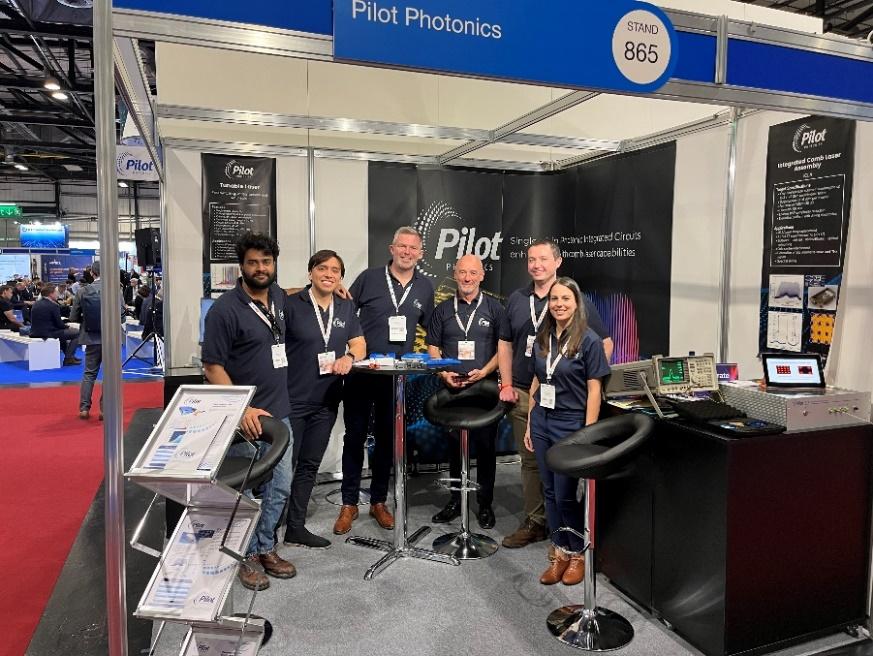
The European Conference on Optical Communication (ECOC) was held over 4 days at the SEC in Glasgow, Scotland in October 2023. Pilot Photonics was there to showcase our latest developments in optical comb and tunable laser technology. It was the 49th edition of the conference, which brings together over 6,700 visitors and 300 exhibitors to discuss their latest breakthroughs and offerings. Visitors to our booth were particularly interested in our widely-tunable lasers in the O-band and C-band. These lasers span 35 nm and offer “step & sweep” tuning today, with a quasi-continuous tuning version coming soon. The lasers are suitable for applications in coherent optical communications in both telecoms and datacoms, fibre sensing, FMCW LiDAR and more. Pilot’s team was led by our CEO, William Oppermann, our founder and CTO, Dr. Frank Smyth, our Director of Sales Damian McGillivary and supported by our team of scientists and engineers who connected with our visitors and enjoyed positive feedback and engaging conversations. Aside from the trade show, our senior photonics engineer, Dr. Caolán Murphy, had the chance to deliver a talk explaining our progress with O-band tunable lasers to a crowd of more than 100 industry and academic professionals devoted to next-generation lasers and detectors. Dr. Murphy described our integrated fast-switching, tunable lasers with SOAs, capable of 14 dBm of laser output power and with linewidths of 150 kHz or less. We extend our gratitude to everyone who visited our booth, engaged in insightful discussions, and expressed interest in our technologies. In 2024, ECOC will be in Frankfurt, Germany and we hope to see you there. For those who couldn’t join us at ECOC 2023, we invite you to explore our showcased products at wwwpilotphotonics.com/products.
ECOC 2022: PILOT USES JePPIX SERVER FOR PHOTONICS TECH
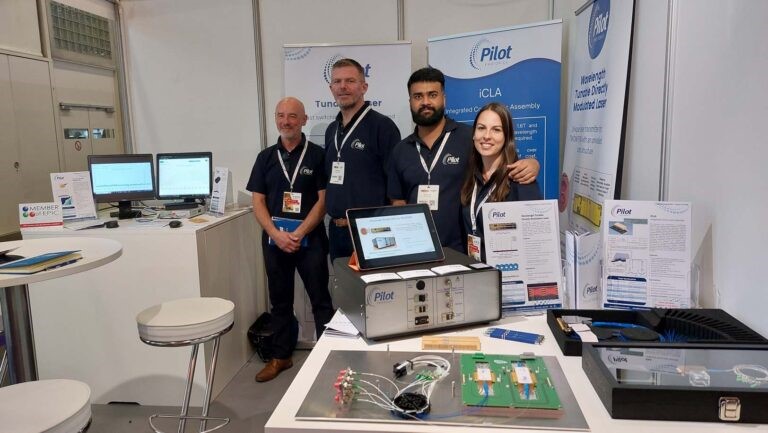
Pilot Photonics demonstrated three new products at ECOC2022 which emanated from the JePPIX platform. These include a low linewidth fast tuneable laser, an InP-based monolithic single mode laser in the C-band; an integrated Comb Laser Assembly (iCLA) for scaling coherent transceiver capacity, and SuperTROSA™ a comb-based superchannel transmitter. Low Linewidth Fast Tunable Laser has a tuning range of > 30nm centered at 1550 nm, with high side-mode suppression ratio. It offers linewidth < 150kHz and low power consumption. This laser is currently offered in a standard 14-pin butterfly package, with a thermo-electric cooler, internal isolators, and polarisation-maintaining fibre pigtail with FC/APC connectors. Development in a nano-iTLA formfactor is underway. The integrated comb laser assembly (iCLA) incorporates a monolithically integrated comb laser and demultiplexer that supplies four or more simultaneously generated coherent, phase matched outputs on separate fibres, replacing up to 4 integrated tuneable laser assemblies (iTLAs). It is designed for driving multiple 400G/800G coherent optical engines on individual fibres from a single laser module. This patented source technology offers the ability to tune the wavelength separation of the four outputs, while maintaining the coherent and phase-matched characteristics, reducing the required DSP complexity The TERA-4-TX is a transmit side optical engine for next-generation coherent superchannel transceivers. It combines a wavelength-tuneable, integrated comb source and demux that supply four simultaneously generated coherent wavelengths to an array of dual polarisation IQ modulators. “JePPIX has allowed us to offer PICS with enhanced performance and capability and enabled us to target new industry verticals,” says Frank Smyth, founder and chief technology officer of Pilot Photonics. Kevin Williams, Professor and chair of the Photonic Integration group at TU Eindhoven, a JePPIX partner, considers it “an excellent example of how an early-stage company can create new products that may route to production thanks to the JePPIX Pilot Line”. Source: Optical Connections
“MWP4SPACE” DOCTORAL TRAINING NETWORK FORMALLY COMMENCES
Pilot Photonics joined partners from around Europe to formally commence the EU-funded Doctoral Training Network entitled MicroWave Photonic Technologies for Communication and Sensing Applications in Space (MWP4SPACE).The MWP4SPACE project will train specialists in Integrated Microwave Photonic (IMWP) devices and systems in the framework of satellite and space applications. MWP4SPACE will offer an education program for 15 doctoral candidates structured in research projects and network‐wide training activities. Pilot Photonics is an associated partner in the training network which is formed by 6 European Universities, 1 non‐profit academic research institution and 9 companies that are world‐class references in both photonics and space technologies.
Pilot Photonics participated at ECOC 2022 in Basel

Pilot Photonics attended the European Conference on Optical Communication in Basel this September. The company took its largest trade show booth to date, and six members of the Pilot team demonstrated a number of new and existing products and technologies during a busy three days at the show. The products on display were Off the booth, Pilot Photonics’ CTO Dr. Frank Smyth presented a talk on Pilot’s integrated comb laser assembly (iCLA) at the Product Focus Session. The slides from the talk can be downloaded here [ LINK TO CONTENT].He also spoke about the same technology to the ECOC TV team, and that interview can be viewed below.